
The 2026 Safety Paradox:
Why Digital Transformation is Creating a New Breed of Human Error
(And How to Bridge the Gap)
The Invisible Risk in the Visible Factory
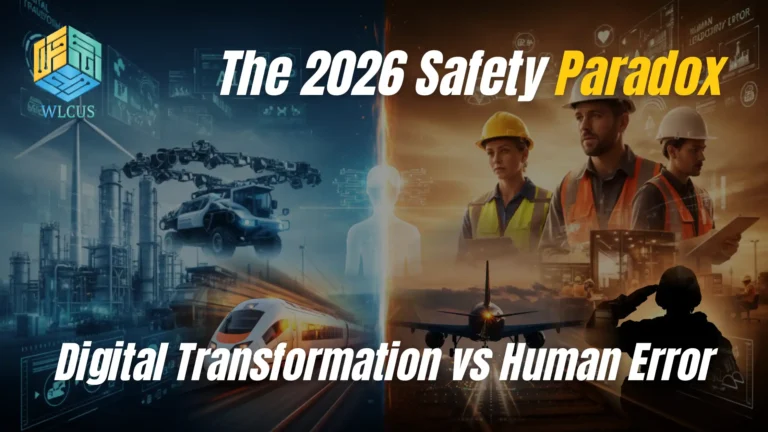
As we approach the mid-way point of the decade, heavy industries, from Rail and Energy to Mining and Chemicals, are celebrating a milestone, the “Visible Factory”. We have more data, more sensors, and more AI-enabled oversight than ever before. Yet, a chilling paradox is emerging. Despite the digital “safety net” serious incidents and near-misses are not disappearing, they are evolving.
This is the 2026 Safety Paradox: The very technology designed to eliminate human error is creating a new breed of it. As the physical hazards of the shop floor are mapped and mitigated by AI, they are being replaced by Cognitive Hazards, digital complacency, alarm fatigue, and a widening “competence gap”.
To lead in this new era, HSE (Health, Safety, and Environment) professionals must shift their focus from monitoring the machine to understanding the human-machine interface. Our Studies & Research explores the root causes of this paradox and provides a strategic framework for bridging the gap, culminating in the critical discussions set for the Global HSE Nexus 2.0 in Berlin.
1. The Anatomy of a New Era: Digital Complacency
For decades, safety was a matter of physical barriers. Today, it is a matter of digital trust. However, “trusting the system” has a dangerous side effect as well, that is Digital Complacency.
When a worker in a high-risk sector like Rail or Oil & Gas is told that an AI-driven “Control Tower” is monitoring their environment for hotspots, their personal vigilance naturally drops. We see this in the “Silent Indicator” trend, where workers stop scanning their surroundings because they assume the sensor will catch the risk for them.
The Research Reality: Studies into High-Reliability Organizations (HROs) suggest that when human operators become “monitors of monitors,” their ability to react to a sudden, manual crisis atrophies. In 2026, the risk isn’t that the AI will fail; it’s that the human will be too “digitally sedated” to notice when it does.
2. Industry Deep-Dive: Where the Paradox Hits Hardest
The 2026 Safety Paradox does not affect every industry equally. It is most prevalent in sectors where the “High-Risk, Low-Frequency” (HRLF) event is the primary threat.
Rail & Infrastructure: The Interoperability Crisis
In Europe and the Middle East, the rapid expansion of high-speed rail and digital signaling (ETCS) has created a complex web of technical interoperability. Drivers are now navigating digital interfaces that can vary across borders. The hazard here is Cognitive Overload. When a driver has to process conflicting digital inputs while maintaining high-speed vigilance, the risk of a “signal passed at danger” (SPAD) increases, not because of a lack of skill, but because of a “system blind spot”.
Renewable Energy & Utilities: The "New Energy" Knowledge Gap
As we pivot to Hydrogen and Offshore Wind, we are introducing workers to hazards they have never seen before. Because these industries are “born digital,” training often relies heavily on remote modules. However, as the data shows, you cannot automate Muscle Memory. A technician might pass a digital quiz on hydrogen leak protocols but freeze when the physical pressure drops in a real-world offshore environment.
3. The Bridge: From Compliance to Cognitive Competence
To solve the paradox, HSE leaders must move beyond traditional EHS management software and adopt a Human-Centric Technology approach. This involves three critical pillars:
Pillar I: VR Scenario Replication & Stress Loading
Traditional training tells you what to do, immersive VR allows you to experience the consequences of doing it wrong. By using Virtual Reality for HRLF events, like fire safety or emergency response in Mining and many among the High Risk Industries can build “safe failure” into their culture. This bridges the gap between digital theory and physical competence.
Pillar II: Predictive Analytics & "Hotspot" Transparency
Instead of using data to audit what happened in the past, leading operators are using Predictive Analytics to identify “hotspots” before they become fatalities. The key is transparency, sharing these digital hotspots with the front-line workers so they can reclaim their vigilance, rather than keeping the data in a C-suite dashboard.
Pillar III: Psychological Safety as a Lead Indicator
The “S” in ESG is finally taking center stage. In 2026, we recognize that a worker who is mentally exhausted or afraid to report a “glitch” in the digital system is a physical liability. Integrating mental well-being and “speak-up” culture into the HSE framework is the only way to ensure the digital system reflects the physical reality.
4. The 2030 Roadmap: Leading the Transition
Why Berlin 2026 is the Nexus of this Change: The Global HSE Nexus 2.0 is specifically designed to address these 2026 paradoxes. With dual tracks focused on Technology & Innovation and Human Leadership & Culture, the event provides the exact “blueprint” needed to bridge the digital-physical gap.
Key Benchmarking Areas for 2026:
AI HSE Assistant Test Drives: Learning how to use AI as a co-pilot, not a replacement.
Neurodiversity in Safety: Understanding how different brains process digital risk.
Digital Twins for Oil & Gas: Replicating entire plants to test safety protocols without risking a single life.
The Choice for HSE Leaders
We are at a crossroads. We can continue to buy more technology and hope it makes us safer, or we can choose to Elevating Safety, Empowering Leadership in AI Era, by putting the human back at the center of the digital era.
The 2026 Safety Paradox is a warning, but it is also an opportunity. Those who master the human-machine interface will not only reduce incidents; they will build the most resilient, sustainable, and high-performing organizations of the decade.
The study continues in Berlin. Are you ready to solve the paradox?
Join the Global Dialogue. Shape the Future with a safe Culture. 👉 Register for the Global HSE Nexus 2.0 (Berlin)