
Beyond the Reference Man:
Why 2026 Requires Inclusive Safety Mandates
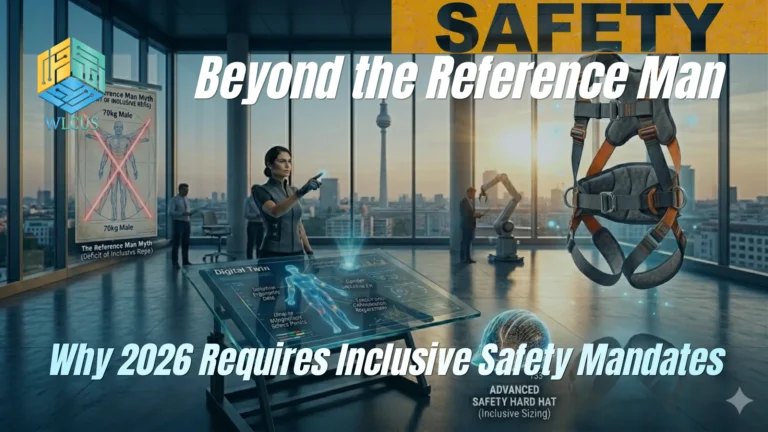
For decades, the global industrial sector, from the oil rigs of the North Sea to the pharmaceutical labs of Basel, has operated under a hidden biological bias. Since the mid-20th century, the “Standard” for safety engineering, chemical exposure limits, and equipment design has been the “Reference Man”: a 70kg, 1.75m male.
As we reach the 2026 Tipping Point, WLCUS research confirms that this “One-Size-Fits-All” approach is no longer just a social diversity issue; it is a critical operational failure. To achieve true high-reliability performance, organizations must move beyond mere representation and toward Inclusive Safety Mandates.
Empowering women within these mandates is the only way to close the widening “Data-Rigor Gap” and address the Serious Injury and Fatality (SIF) potential that remains hidden in a non-inclusive workplace.
1. The PPE Fit Crisis: A Technical Hazard, Not a Fashion Choice
In early 2026, data from EU-OSHA and various global HSE bodies underscored a startling reality: ill-fitting Personal Protective Equipment (PPE) is a primary driver of preventable workplace injuries among women.
When a female engineer is issued gloves designed for a larger male hand, her manual dexterity is reduced by up to 25%, increasing the risk of “caught-in” accidents. When a fall-arrest harness is not designed for the female center of gravity, the risk of “suspension trauma” increases significantly during a fall. These are not inconveniences; they are technical hazards that compromise the integrity of your safety barriers.
The 2026 Mandate: Inclusive safety requires Sex-Disaggregated Fit Testing. Empowering women in safety means moving them into procurement and design roles where they can mandate equipment that protects every body on the worksite. This is a shift from “Standard Issue” to “Inclusive Specification.”
2. Closing the "Data-Rigor Gap" with Gender-Sensitive Risk Assessment
One of the core themes of the Global HSE Nexus 2.0 is the transition to “Decision-Quality” data. However, data is only as good as its inputs. If your risk assessment models only account for the physiological responses of the “Reference Man,” your data is fundamentally flawed.
Traditional risk assessments often overlook the biological and social realities of the female workforce. 2026 research highlights that women often face different musculoskeletal stressors and higher cumulative exposure risks in high-intensity environments.
The Diversity Dividend: By empowering women to lead risk-assessment committees, organizations gain a “Diversity Dividend.” Women are statistically more likely to identify Psychosocial Risks, such as burnout, harassment, and the “double-burden” of caregiving, that impact cognitive focus and, ultimately, physical safety. When these “invisible” risks are captured, the Board receives a more accurate picture of organizational resilience.
3. The Psychological Safety Premium and "Speak-Up" Culture
The modern workforce, specifically the incoming Gen Z cohort, demands more than physical protection. They demand Psychological Safety.
In high-hazard industries, the “Alpha” culture has historically suppressed the reporting of “near-misses”, leading to a dangerous “Safety Silence”. Research indicates that female HSE leaders are instrumental in breaking this silence. By fostering an environment where vulnerability is treated as a strategic strength, women in leadership roles lower the barrier to reporting. This allows SIF precursors to be identified and neutralized before they lead to catastrophe.
4. Inclusive Primary Healthcare: The New Frontier of Occupational Health
As we look toward 2030, the definition of “Occupational Health” is expanding. Inclusive mandates must now account for hormonal cycles, menopause, and reproductive health as critical factors in cognitive safety.
Empowering women in safety mandates means creating policies that don’t treat these stages as “medical issues” but as biological variables. A safety culture that supports a woman through menopause with cooling stations and flexible breaks is a culture that is actively preventing heat-stress and cognitive-fatigue incidents. This is the hallmark of a Human-Centric HSE strategy.
5. Redefining Leadership for the "Human-Machine Interface"
With the rise of Agentic AI and Digital Twins, the role of the HSE professional is shifting from “inspector” to “system orchestrator.”
Women are uniquely positioned to lead this transition. Research into leadership styles suggests that female leaders often excel in integrative thinking—the ability to see the connections between disparate systems. In a 2026 industrial environment, where a single software glitch can have the same impact as a mechanical failure, this holistic view is essential for maintaining the “Presence of Capacity”.
The WLCUS Vision: Leading the Change in Berlin
At WLCUS, we don’t just observe trends, we curate the solutions. Our research shows that companies with gender-diverse safety boards see a 17% higher engagement rate in safety protocols.
This is why the Global HSE Nexus 2.0 in Berlin (May 6-7, 2026) features dedicated sessions on Inclusive Safety Design and The Future of Human-Centric HSE. We are bringing together pioneers who are successfully dismantling the “Reference Man” myth to build a more resilient, data-driven, and inclusive industrial future.
JOIN THE INCLUSIVE REVOLUTION
The time for “special treatment” is over. The time for Evidence-Based Prevention is here.
1. Join the Summit at Grand Hyatt Berlin
Experience the masterclasses and panels that are setting the global standard for 2026.
The 3-FOR-2 Executive Pass: Align your HR, Diversity, and HSE leads. Book 2 Premium seats, and your 3rd executive joins for FREE.
👉 REGISTER FOR GLOBAL HSE NEXUS 2.0
2. Explore the Research: Why Safety Efforts Plateau
Understand how inclusive leadership and psychological safety can break the cycle of stagnant performance.
About WLCUS:
WLCUS is the world’s premier organizer of strategic HSE summits. We partner with organizations like IIRSM, NEBOSH, and the Krause Bell Group to turn academic research into operational reality.
Contact for Group Bookings: booking@wlcus.com | +36 30 828 2239