
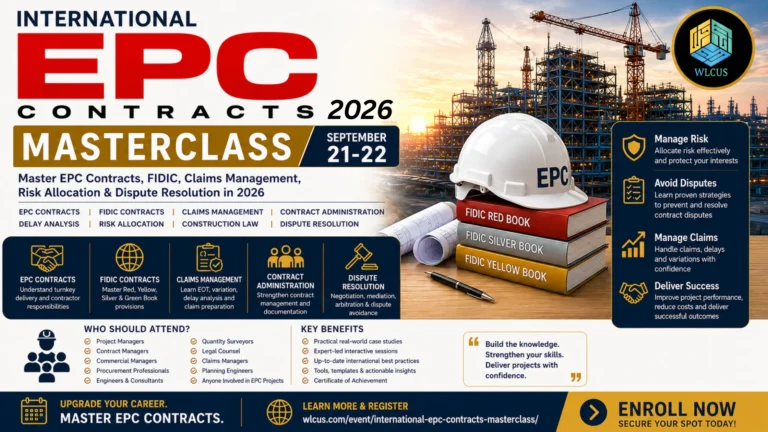
Why Every Project Professional Should Master EPC Contracts
The success of a construction or infrastructure project is not determined solely by engineering excellence. In today’s global market, successful delivery depends just as much on how contracts are drafted, administered, and managed throughout the project lifecycle.
Whether you are involved in energy, oil and gas, renewable energy, transportation, manufacturing, mining, water infrastructure, or industrial construction, understanding EPC contracts has become an essential professional skill.
With projects becoming larger, more international, and increasingly complex, organisations across Europe are investing in professionals who can effectively manage commercial risk, contractual obligations, claims, and dispute prevention.
This is exactly why the International EPC Contracts Masterclass has been developed,to help professionals understand the complete lifecycle of Engineering, Procurement and Construction contracts while learning practical strategies that can be applied immediately on real projects.
What Are EPC Contracts?
Engineering, Procurement and Construction (EPC) contracts are one of the most widely used procurement models for delivering major infrastructure and industrial projects.
Under an EPC contract, a single contractor is responsible for:
- Engineering and design
- Procurement of equipment and materials
- Construction
- Testing and commissioning
- Final delivery of a fully operational facility
Because one contractor assumes responsibility for delivering the completed project, EPC contracts are often referred to as Turnkey Contracts.
This model provides employers with greater certainty over cost, schedule, and project performance while placing greater responsibility on the contractor for successful delivery.
Industries That Commonly Use EPC Contracts
EPC contracts are widely adopted across sectors including:
- Oil & Gas
- Renewable Energy
- Solar Projects
- Wind Farms
- Hydrogen Infrastructure
- Power Generation
- Petrochemical Plants
- Manufacturing Facilities
- Data Centres
- Water Treatment Plants
- Airports
- Rail Infrastructure
- Mining
- Heavy Industrial Construction
As governments continue investing in sustainable infrastructure and energy transition projects, demand for professionals with EPC contract expertise continues to grow.
What Is FIDIC?
One of the biggest misconceptions in the construction industry is assuming that EPC contracts and FIDIC contracts are the same.
They are not.
FIDIC (International Federation of Consulting Engineers) publishes internationally recognised standard contract forms used on construction and infrastructure projects worldwide.
These contracts provide a structured legal framework that clearly defines the rights, responsibilities, and risk allocation between employers, contractors, and engineers.
Among the most recognised forms are:
- Red Book
- Yellow Book
- Silver Book
- Green Book
- Gold Book
The Silver Book is particularly relevant for EPC and turnkey projects because it allocates a greater share of design and construction risk to the contractor.
Understanding how EPC delivery models interact with FIDIC contract forms is essential for anyone managing international projects.
Why EPC Contract Knowledge Matters More Than Ever
Across Europe, organisations are facing growing pressure from:
- Rising material costs
- Supply chain disruption
- Labour shortages
- Renewable energy expansion
- Increasing contract disputes
- Complex international procurement
- Sustainability requirements
- Digital transformation
As project values continue to increase, even small contractual misunderstandings can result in significant financial consequences.
Professionals who understand contract administration, claims management, risk allocation, and dispute avoidance are becoming increasingly valuable across the construction sector.
Common Causes of EPC Contract Disputes
Many project disputes are not caused by technical failures.
Instead, they arise from poor contract management.
Some of the most common causes include:
Poor Scope Definition
Unclear project requirements often lead to disagreements regarding contractor obligations and variation orders.
Inadequate Contract Administration
Failure to properly administer notices, approvals, and contractual procedures increases project risk.
Design Changes
Late design modifications frequently result in delays, cost overruns, and commercial disputes.
Delay Claims
Project delays remain one of the leading causes of contractual disagreements.
Proper documentation and timely notifications are critical for Extension of Time (EOT) claims.
Poor Record Keeping
Without accurate records, organisations struggle to justify claims or defend against them during dispute resolution.
Risk Allocation
Improper allocation of commercial risk often creates disputes that could have been prevented during contract negotiation.
Essential Skills Every EPC Professional Should Develop
Modern EPC projects require professionals who can combine technical knowledge with commercial awareness.
Key competencies include:
- EPC Contract Management
- Contract Administration
- FIDIC Contract Interpretation
- Claims Management
- Construction Law Fundamentals
- Delay Analysis
- Extension of Time (EOT)
- Risk Allocation
- Variation Orders
- Commercial Negotiation
- Procurement Strategy
- Dispute Resolution
- Construction Arbitration
- Insurance in EPC Projects
These skills help organisations reduce disputes while improving project performance and commercial outcomes.
Why Claims Management Is One of the Most Valuable Skills
Construction claims are an unavoidable part of many large projects.
However, successful organisations understand that claims should be managed proactively rather than reactively.
Effective claims management involves:
- Early identification of contractual risks
- Accurate documentation
- Timely contractual notices
- Cost analysis
- Delay evaluation
- Negotiation strategies
- Evidence-based decision making
Professionals who understand claims management help organisations protect profitability while maintaining strong client relationships.
Contract Administration: The Foundation of Successful Projects
Contract administration is often underestimated.
Yet it is one of the most important functions within an EPC project.
Effective contract administration ensures that:
- Contract obligations are fulfilled
- Project documentation is maintained
- Contractual notices are issued correctly
- Variations are managed appropriately
- Payment procedures are followed
- Risks are monitored continuously
Strong contract administration reduces uncertainty while improving collaboration between project stakeholders.
Delay Analysis and Extension of Time (EOT)
Project delays continue to be one of the largest sources of construction disputes.
Understanding delay analysis enables professionals to:
- Identify causes of delay
- Distinguish excusable and non-excusable delays
- Assess concurrent delays
- Prepare Extension of Time claims
- Minimise project disruption
- Reduce litigation risk
Delay analysis has become a critical competency for project managers, planners, and contract professionals working on major infrastructure developments.
Risk Allocation in EPC Contracts
Not every disagreement becomes litigation.
Many disputes can be resolved through structured contractual mechanisms, including:
- Negotiation
- Mediation
- Adjudication
- Arbitration
- Expert determination
Learning dispute avoidance techniques is often more valuable than resolving disputes after they arise.
Dispute Resolution and Arbitration
One of the defining characteristics of EPC contracts is the allocation of project risk.
Successful contracts establish clear responsibilities regarding:
- Design liability
- Performance guarantees
- Procurement obligations
- Construction risks
- Insurance requirements
- Force majeure
- Defects liability
- Warranties
- Indemnities
- Limitation of liability
Understanding these provisions allows organisations to negotiate more balanced agreements while protecting long-term commercial interests.
Who Should Attend an EPC Contracts Masterclass?
This training is particularly valuable for:
- Project Managers
- Contract Managers
- Commercial Managers
- Procurement Managers
- Construction Managers
- Quantity Surveyors
- Legal Counsel
- Engineers
- Project Directors
- Planning Engineers
- Claims Managers
- Cost Engineers
- Business Development Managers
- Procurement Specialists
- Consultants
Whether you work for a contractor, employer, consultant, or government organisation, a strong understanding of EPC contracts improves project performance and commercial decision-making.
Benefits of Attending the International EPC Contracts Masterclass
The International EPC Contracts Masterclass has been designed to provide practical, industry-focused knowledge rather than purely theoretical learning.
Participants will gain practical insights into:
- EPC Contracts
- EPCM and EPIC Contracts
- FIDIC Contract Forms
- Contract Formation
- Tendering Procedures
- Procurement Strategies
- Contract Administration
- Design Liability
- Risk Allocation
- Variation Orders
- Delay Analysis
- Claims Management
- Insurance
- Termination
- Dispute Resolution
- International Best Practices
The programme combines expert instruction with practical case studies, helping participants apply knowledge immediately within their own organisations.
At WLCUS, we focus on delivering practical learning experiences led by industry professionals with extensive international expertise.
Our programmes are designed to address real-world commercial challenges faced by project teams across Europe and beyond.
Through interactive sessions, practical examples, and discussion of current industry practices, participants gain knowledge that supports both individual professional development and organisational success.
If you are looking to strengthen your expertise in EPC Contracts, FIDIC, claims management, contract administration, risk allocation, and dispute resolution, this masterclass provides an excellent opportunity to learn from experienced practitioners.
👉 Learn more and register today:
https://wlcus.com/event/international-epc-contracts-masterclass/
Invest in your professional development and gain the practical skills needed to manage contracts with greater confidence, reduce project risk, and deliver successful outcomes.