
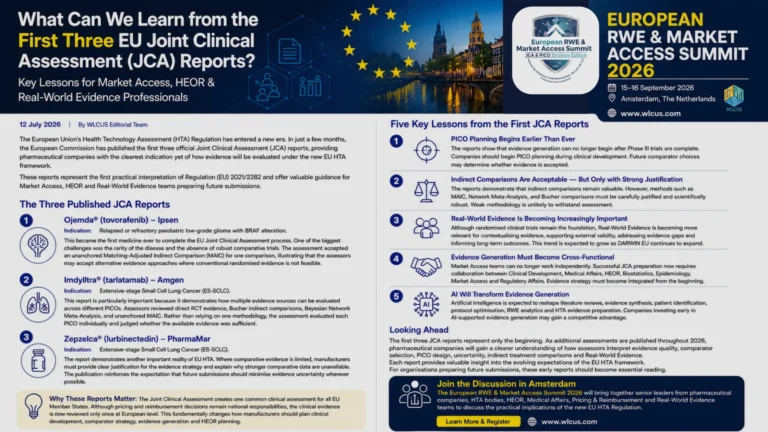
The European Union’s Health Technology Assessment (HTA) Regulation has entered a new era.
In just a few months, the European Commission has published the first three official Joint Clinical Assessment (JCA) reports, providing pharmaceutical companies with the clearest indication yet of how evidence will be evaluated under the new EU HTA framework.
The reports cover:
Ojemda (tovorafenib) — Ipsen
Imdylltra (tarlatamab) — Amgen
Zepzelca (lurbinectedin) — PharmaMar
Together, these reports represent the first practical interpretation of Regulation (EU) 2021/2282 and offer valuable guidance for Market Access, HEOR and Real-World Evidence teams preparing future submissions.
Why These Reports Matter
For years, pharmaceutical companies prepared evidence separately for each national HTA body.
Today, the Joint Clinical Assessment creates one common clinical assessment for all EU Member States.
Although pricing and reimbursement decisions remain national responsibilities, the clinical evidence is now reviewed only once at European level.
This fundamentally changes how manufacturers should plan:
Clinical development
Comparator strategy
Evidence generation
PICO planning
Indirect treatment comparisons
HEOR planning
Real-World Evidence generation
The first reports demonstrate exactly what assessors expect.
The Three Published JCA Reports
1. Ojemda (tovorafenib)
Company: Ipsen
Indication
Relapsed or refractory paediatric low-grade glioma with BRAF alteration.
This became the first medicine ever to complete the EU Joint Clinical Assessment process.
One of the biggest challenges was the rarity of the disease and the absence of robust comparative trials.
The assessment accepted an unanchored Matching-Adjusted Indirect Comparison (MAIC) for one comparison, illustrating that the assessors may accept alternative evidence approaches where conventional randomised evidence is not feasible.
2. Imdylltra (tarlatamab)
Company: Amgen
Indication
Extensive-stage Small Cell Lung Cancer (ES-SCLC).
This report is particularly important because it demonstrates how multiple evidence sources can be evaluated across different PICOs.
Assessors reviewed:
Direct RCT evidence
Bucher indirect comparisons
Bayesian Network Meta-Analysis
Unanchored MAIC
Rather than relying on one methodology, the assessment evaluated each PICO individually and judged whether the available evidence was sufficient.
This highlights the increasing importance of early evidence planning and robust comparator selection.
3. Zepzelca (lurbinectedin)
Company: PharmaMar
Indication
Extensive-stage Small Cell Lung Cancer.
The report demonstrates another important reality of EU HTA.
Where comparative evidence is limited, manufacturers must provide clear justification for the evidence strategy and explain why stronger comparative data are unavailable.
The publication reinforces the expectation that future submissions should minimise evidence uncertainty wherever possible.
Five Key Lessons from the First JCA Reports
1. PICO Planning Begins Earlier Than Ever
The reports show that evidence generation can no longer begin after Phase III trials are complete.
Companies should begin PICO planning during clinical development.
Future comparator choices may determine whether evidence is accepted.
Not every uncertainty carries the same commercial impact.
Understanding which evidence gaps could delay patient access allows organisations to focus investment where it matters most.
2.Indirect Comparisons Are Acceptable — But Only with Strong Justification
The reports demonstrate that indirect comparisons remain valuable.
However, methods such as:
MAIC
Network Meta-Analysis
Bucher comparisons
must be carefully justified and scientifically robust.
Weak methodology is unlikely to withstand assessment.
3.Real-World Evidence Is Becoming Increasingly Important
Although randomised clinical trials remain the foundation, Real-World Evidence is becoming more relevant for:
contextualising evidence
supporting external validity
addressing evidence gaps
informing long-term outcomes
This trend is expected to grow as DARWIN EU continues to expand.
4. Evidence Generation Must Become Cross-Functional
Market Access teams can no longer work independently.
Successful JCA preparation now requires collaboration between:
Clinical Development
Medical Affairs
HEOR
Biostatistics
Epidemiology
Market Access
Regulatory Affairs
Evidence strategy must become integrated from the beginning.
5. AI Will Transform Evidence Generation
Artificial Intelligence is expected to reshape:
literature reviews
evidence synthesis
patient identification
protocol optimisation
RWE analytics
HTA evidence preparation
Companies investing early in AI-supported evidence generation may gain a competitive advantage.
Looking Ahead
The first three JCA reports represent only the beginning.
As additional assessments are published throughout 2026, pharmaceutical companies will gain a clearer understanding of how assessors interpret:
Evidence quality
Comparator selection
PICO design
Uncertainty
Indirect treatment Comparisons
Real-World Evidence
Each report provides valuable insight into the evolving expectations of the EU HTA framework.
For organisations preparing future submissions, these early reports should become essential reading.
Join the Discussion in Amsterdam
The European RWE & Market Access Summit 2026 will bring together senior leaders from pharmaceutical companies, HTA bodies, HEOR, Medical Affairs, Pricing & Reimbursement and Real-World Evidence teams to discuss the practical implications of the new EU HTA Regulation.
Topics include:
Lessons from the first Joint Clinical Assessment reports
PICO strategy and evidence planning
DARWIN EU implementation
AI in Market Access and Evidence Generation
Real-World Evidence for HTA
Pricing & Reimbursement strategy under the new EU HTA framework
If your organisation is preparing for future EU Joint Clinical Assessments, this summit provides an opportunity to learn directly from the experts shaping the next generation of evidence strategy.