
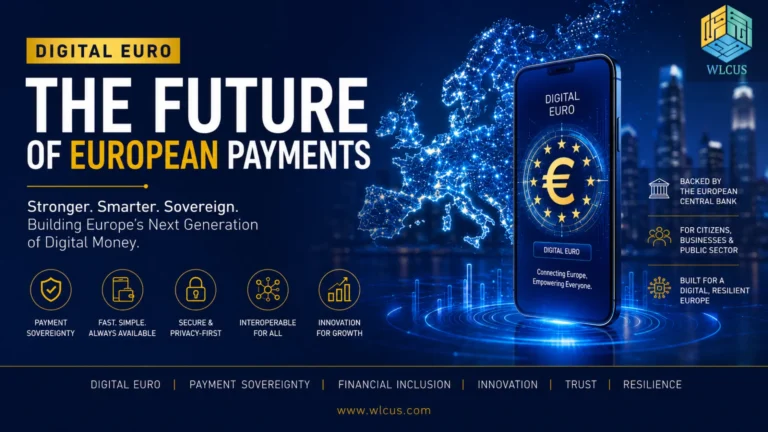
As Europe accelerates toward a digital economy, one initiative is attracting unprecedented attention from central banks, financial institutions, payment providers, fintech innovators, merchants, and policymakers alike, the Digital Euro.
Designed by the European Central Bank (ECB), the Digital Euro represents far more than another payment method. It is Europe’s strategic response to a rapidly evolving payments ecosystem increasingly influenced by global technology companies, private digital currencies, and geopolitical uncertainty.
For banks, payment providers, merchants, and businesses operating across Europe, understanding the Digital Euro is no longer optional, it is becoming a strategic priority.
What is the Digital Euro?
The Digital Euro is a proposed Central Bank Digital Currency (CBDC) issued directly by the European Central Bank.
Unlike cryptocurrencies such as Bitcoin or Ethereum, the Digital Euro would:
Be fully backed by the ECB
Maintain the same value as physical euro cash
Be accepted across all Eurozone countries
Function alongside cash, not replace it
Offer secure digital payments across Europe
Simply put, it would become digital public money, giving citizens and businesses another trusted payment option in an increasingly digital economy.
Why Europe Needs a Digital Euro
Europe’s payments ecosystem is changing rapidly.
Consumers increasingly rely on:
International card networks
Mobile wallets
Instant payment apps
Digital banking platforms
Big Tech payment solutions
While these services offer convenience, they also create growing dependence on private payment infrastructures.
The Digital Euro aims to ensure that Europe maintains:
Payment sovereignty
Financial stability
Strategic autonomy
Inclusive digital payments
Competitive innovation
The initiative is as much about Europe’s economic resilience as it is about technology.
The Five Strategic Objectives Behind the Digital Euro
1. Strengthening European Payment Sovereignty
One of the ECB’s biggest motivations is reducing Europe’s dependence on non-European payment providers.
Currently, a significant portion of European card transactions relies on global payment schemes.
A Digital Euro would provide Europe with:
Public payment infrastructure
Reduced dependency on external providers
Greater resilience during geopolitical uncertainty
Long-term strategic control of payment systemsFor policymakers, this represents a major step toward financial independence.
2. Supporting Innovation Across European Payments
The Digital Euro is expected to encourage innovation rather than compete with private financial institutions.
Banks and payment providers could build new services including:
Smart payment applications
Programmable business payments
Automated settlements
Cross-platform digital wallets
Machine-to-machine transactions
IoT commerce
Instead of replacing existing payment providers, the Digital Euro could become the foundation upon which new financial services are developed.
3. Maintaining Privacy While Fighting Financial Crime
Privacy remains one of the most discussed aspects of the Digital Euro.
The ECB has repeatedly emphasized that:
Personal payment information should remain protected.
The ECB would not monitor how citizens spend their money.
Anti-money laundering (AML) and counter-terrorism financing (CTF) requirements would still apply.
Finding the right balance between privacy and regulatory compliance will be one of the project’s greatest challenges.
4. Financial Inclusion Across Europe
Not every European citizen has equal access to digital financial services.
The Digital Euro seeks to provide a universal payment method available to:
Consumers
Businesses
Government organizations
Individuals without traditional banking access
Rural communities
Older populationsEnsuring everyone can participate in Europe’s digital economy is one of the initiative’s central objectives.
5. Building a More Resilient Payment Infrastructure
Europe has experienced growing concerns around cyber threats, operational disruptions, and geopolitical risks.
The Digital Euro is expected to strengthen resilience by providing:
Alternative payment rails
Offline payment capabilities (under development)
Secure public infrastructure
Faster payment processing
Reduced systemic dependency
This additional layer of resilience could become increasingly important during major disruptions.
What Does This Mean for Banks?
Commercial banks will play a critical role in the Digital Euro ecosystem.
Rather than being replaced, banks are expected to:
Distribute Digital Euro wallets
Perform customer onboarding
Conduct KYC verification
Deliver customer support
Develop value-added financial services
However, banks must also prepare for new operational models and evolving customer expectations.
Impact on Payment Service Providers and FinTechs
For payment companies, the Digital Euro creates both opportunities and challenges.
Potential opportunities include:
New wallet solutions
Merchant acceptance platforms
Cross-border payment innovations
API integrations
Identity verification services
Value-added payment experiences
Companies that adapt early may gain a significant competitive advantage.
Benefits for Businesses and Merchants
Businesses across Europe could benefit from:
Faster settlements
Lower payment friction
Greater payment certainty
Enhanced interoperability
Simplified cross-border commerce
Reduced dependence on individual payment providers
Merchants may eventually have more flexibility in choosing payment acceptance methods.
Challenges Still Ahead
Although the vision is ambitious, several important questions remain:
Privacy Expectations
Consumers expect strong privacy protections while regulators require effective financial crime controls.
Balancing these priorities will be essential.
Commercial Bank Liquidity
Large-scale movement of deposits into Digital Euro wallets could affect bank funding models.
Appropriate safeguards are expected to be introduced.
Adoption
Consumer adoption cannot be assumed.
Success will depend on:
Ease of use
Merchant acceptance
Trust
Added value compared with existing payment methods
Technical Infrastructure
Offline functionality, interoperability, cybersecurity, and scalability remain significant implementation challenges.
The Bigger Picture: Europe's Digital Future
The Digital Euro is not simply another payment product.
It represents Europe’s broader vision for:
Digital sovereignty
Financial resilience
Public trust
Secure innovation
Competitive financial markets
Its development will influence regulation, banking strategy, payment innovation, fintech investment, and customer experiences for years to come.
Whether businesses operate in banking, payments, fintech, retail, or technology, preparing for this transformation is becoming increasingly important.
Why Payment Leaders Should Be Paying Attention
The introduction of the Digital Euro will reshape conversations around:
Central Bank Digital Currencies (CBDCs)
Instant payments
Open Finance
PSD3 and the future EU payments framework
Cross-border payments
Payment infrastructure modernization
Digital identity
Financial resilience
Merchant payments
Customer experience
These topics are already defining the next generation of European payments and will continue to shape investment and regulatory priorities across the financial sector.
As Europe moves closer to launching the Digital Euro, industry leaders must prepare for one of the most significant changes in modern payment infrastructure.
The Next-Gen Payments Blueprint Summit 2027, organized by WLCUS, will bring together senior executives from banks, payment service providers, fintechs, merchants, regulators, and financial institutions to discuss:
Digital Euro implementation and CBDC readiness
PSD3, PSR and the future regulatory landscape
Instant Payments and SEPA developments
AI in payments and fraud prevention
Open Finance and Embedded Finance
Cross-border payment innovation
Digital identity and payment security
Stablecoins, tokenization and digital assets
The future of European payment infrastructure
Join Europe’s payment leaders as they explore the technologies, regulations, and innovations shaping the future of digital finance.