
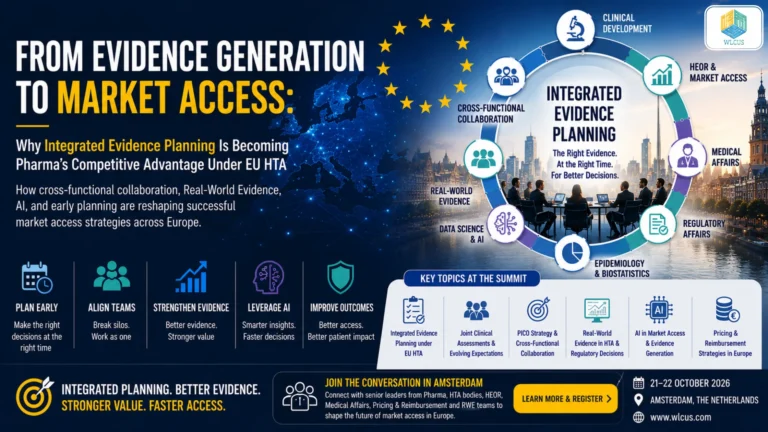
How cross-functional collaboration, Real-World Evidence, AI, and early planning are reshaping successful market access strategies across Europe.
The European pharmaceutical landscape is changing rapidly.
Over the past year, discussions around the EU Health Technology Assessment (HTA) Regulation have largely focused on Joint Clinical Assessments (JCA), PICO development, and evolving evidence requirements. However, an equally important shift is taking place behind the scenes.
Leading pharmaceutical companies are no longer treating Clinical Development, HEOR, Market Access, Medical Affairs, Biostatistics, and Regulatory Affairs as separate functions. Instead, they are moving toward Integrated Evidence Planning (IEP) a coordinated approach to generating the right evidence at the right time for regulators, HTA bodies, payers, and healthcare decision-makers.
As the EU HTA framework matures, integrated evidence planning is becoming a strategic differentiator rather than simply a best practice.
Why the Traditional Approach Is No Longer Enough
Historically, evidence generation followed a linear path.
Clinical teams focused on regulatory approval, while Market Access and HEOR teams often became heavily involved much later, preparing reimbursement submissions after pivotal trial results were available.
The new EU HTA environment demands a different approach.
Under the Joint Clinical Assessment process, decisions around comparators, patient populations, outcomes, and evidence generation need to be considered much earlier. Delaying these discussions can increase uncertainty and make it more difficult to demonstrate value consistently across European markets.
Organizations that integrate evidence planning early are better positioned to support both regulatory and HTA requirements.
What Integrated Evidence Planning Looks Like
An effective integrated evidence strategy brings together expertise from across the organization, including:
- Clinical Development
- Market Access
- HEOR
- Medical Affairs
- Regulatory Affairs
- Epidemiology
- Biostatistics
- Data Science
- Real-World Evidence teams
Rather than working independently, these functions align on key evidence questions from the earliest stages of development.
Together, they consider:
- Which patient populations will be most relevant for HTA?
- Which comparators are likely to be requested?
- What outcomes matter most to patients and payers?
- Where could Real-World Evidence strengthen the evidence package?
- Which uncertainties should be addressed before submission?
This coordinated approach helps reduce duplication, improves evidence consistency, and supports more informed decision-making throughout development.
Real-World Evidence Is Becoming More Strategic
Randomized clinical trials remain the cornerstone of clinical evidence. However, they do not always answer every question relevant to healthcare decision-makers.
Real-World Evidence (RWE) is increasingly being used to:
- Understand treatment effectiveness in routine clinical practice.
- Explore long-term outcomes beyond trial follow-up.
- Provide context for patient populations that may be underrepresented in clinical trials.
- Support healthcare resource utilization analyses.
- Strengthen evidence packages where additional insights are needed.
As European data networks continue to evolve and collaboration across healthcare systems expands, RWE is expected to play an increasingly important role in supporting evidence generation strategies.
Artificial Intelligence Is Accelerating Evidence Generation
Artificial Intelligence is also reshaping how evidence is generated and managed across pharmaceutical organizations.
Today, AI is helping teams:
- Accelerate literature reviews.
- Support evidence synthesis.
- Improve protocol development.
- Assist with medical writing.
- Identify relevant patient cohorts.
- Enhance data analysis workflows.
While AI offers significant opportunities, organizations also recognize the importance of transparency, scientific rigor, and appropriate governance to ensure evidence remains reliable and suitable for regulatory and HTA decision-making.
The most successful organizations are using AI to enhance expert decision-making, not replace it.
Collaboration Is Becoming a Strategic Advantage
One of the biggest lessons emerging across Europe is that successful market access increasingly depends on collaboration.
Organizations that establish strong communication between clinical, medical, regulatory, and commercial teams are often better equipped to respond to evolving evidence requirements and changing payer expectations.
Integrated planning allows companies to identify evidence gaps earlier, align priorities across functions, and prepare more robust value demonstrations before launch.
Looking Ahead
The European evidence landscape will continue to evolve as additional Joint Clinical Assessments are published and experience with the EU HTA Regulation grows.
While individual evidence requirements will differ across therapies, one trend is becoming increasingly clear:
Successful market access will depend not only on generating high-quality evidence, but also on generating the right evidence through coordinated planning across the entire organization.
For pharmaceutical companies preparing future launches, integrated evidence planning is becoming an essential capability rather than an optional process improvement.
Join the Conversation in Amsterdam
As Europe continues to adapt to the evolving EU HTA framework, the European RWE & Market Access Summit 2026 will bring together senior leaders from pharmaceutical companies, HTA bodies, HEOR, Medical Affairs, Pricing & Reimbursement, and Real-World Evidence teams to discuss the future of evidence generation and market access.
Key discussion topics include:
- Integrated Evidence Planning under EU HTA
- Joint Clinical Assessments and evolving evidence expectations
- PICO strategy and cross-functional collaboration
- Real-World Evidence in regulatory and HTA decision-making
- AI applications in Market Access and Evidence Generation
- Pricing & Reimbursement strategies across Europe
- Preparing organizations for the next phase of EU HTA implementation
If your organization is navigating the changing European evidence landscape, this summit offers an opportunity to exchange practical insights, learn from industry experts, and explore strategies that can support future market access success.