
Beyond the Heat Index: Engineering Defensible WBGT-Based
Work–Rest Controls
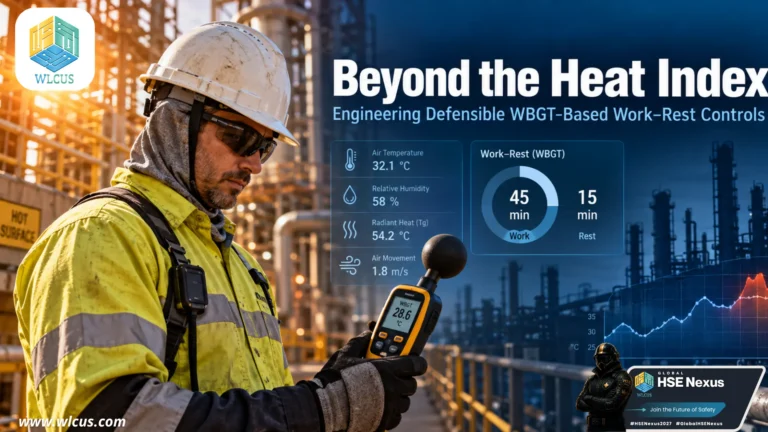
Occupational heat stress is often managed as though it were simply a weather problem: check the forecast, distribute water and tell workers to take more breaks when conditions feel hot.
That approach is inadequate for high-risk operations.
A worker’s thermal burden is not determined by air temperature alone. It is created by the interaction of environmental heat, radiant heat, humidity, air movement, metabolic workload, clothing and personal protective equipment (PPE). Acclimatisation, health status and individual susceptibility can further affect how the same exposure is experienced.
This means that a defensible heat-stress decision cannot begin and end with a weather application or a single sensor reading. Organisations need a structured system that converts changing exposure data into clear operational decisions: continue the task, modify the controls, increase recovery time, rotate personnel or suspend the work.
The objective is not to predict human physiology with perfect precision. It is to make timely, conservative and traceable decisions using the best available evidence.
Why the heat index is not enough
The heat index combines air temperature and relative humidity to describe how hot conditions may feel. It is useful for public weather communication and initial awareness, but it does not fully represent occupational heat exposure.
In particular, the heat index does not directly account for:
radiant heat from furnaces, hot process equipment, roofing materials or direct solar load;
the cooling effect of site-specific air movement;
metabolic heat produced by lifting, climbing, digging or carrying equipment;
the effect of coveralls, chemical-protective clothing or impermeable PPE;
task duration and recovery conditions; or
the worker’s acclimatisation and individual risk factors.
These omissions matter. A maintenance technician working beside a furnace can face serious heat strain even when the outdoor weather appears moderate. Equally, a worker performing heavy manual work in protective clothing may accumulate body heat much faster than a person undertaking light work in ordinary clothing under the same environmental conditions.
The question is therefore not, “What is today’s temperature?”
It is:
What is the worker’s total thermal burden during this task, and what controls are required to keep the exposure within an acceptable operating envelope?
Choosing the correct assessment method
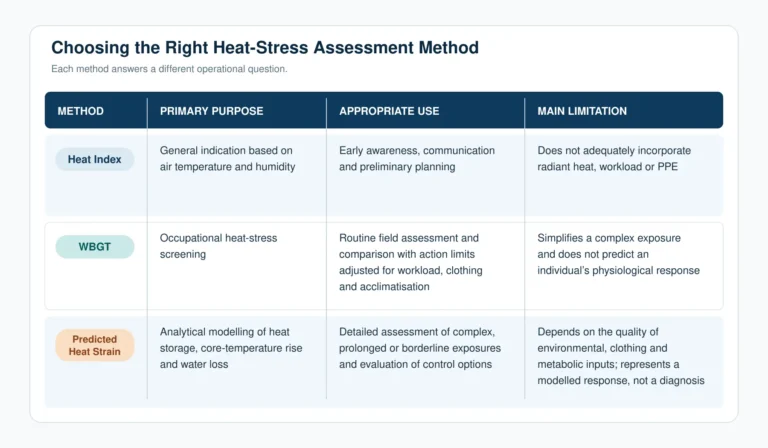
Heat index, Wet Bulb Globe Temperature (WBGT) and Predicted Heat Strain (PHS) are not interchangeable. They answer different questions.
Choosing the correct assessment method
Heat index, Wet Bulb Globe Temperature (WBGT) and Predicted Heat Strain (PHS) are not interchangeable. They answer different questions.
ISO 7243:2017 presents WBGT as a screening method for assessing occupational heat stress over the working day. When screening indicates concern, or when conditions, clothing or work patterns are too complex for a simple index, ISO 7933:2023 provides the PHS model for analytical assessment of thermal strain.
A mature programme uses these methods as layers rather than competitors:
Heat index or weather data for advance awareness.
Task-level WBGT for operational screening and trigger decisions.
PHS or competent specialist analysis for complex, high consequence or uncertain scenarios.
Physiological monitoring and worker observations, where justified, as additional evidence, not as substitutes for environmental control.
Applying WBGT correctly
WBGT integrates natural wet bulb temperature, globe temperature and, in certain conditions, dry bulb temperature. These components capture humidity and evaporative capacity, radiant heat and ambient air temperature more effectively than temperature alone.
Commonly expressed relationships are:
Indoor environments or outdoor environments without direct solar load:
WBGT = 0.7 × natural wet-bulb temperature + 0.3 × globe temperatureOutdoor environments with direct solar load:
WBGT = 0.7 × natural wet-bulb temperature + 0.2 × globe temperature + 0.1 × dry-bulb temperature
The calculation is simple; obtaining a representative measurement is not.
A defensible assessment should establish:
where the instrument is positioned relative to the worker;
whether the reading represents the actual work zone and body height;
whether the task moves between different thermal environments;
whether heat sources cycle or change during the shift;
how long the instrument requires to stabilise;
whether direct sunlight, shielding or nearby surfaces distort the reading;
whether the device has been maintained and calibrated; and
whether time-weighted exposure is required across multiple tasks or locations.
A WBGT monitor positioned in a shaded office doorway does not represent a worker exposed to solar radiation on a roof. Nor does a single morning measurement represent an afternoon task beside equipment that becomes progressively hotter.
The measurement strategy must follow the exposure.
Workload is part of the heat exposure
Environmental measurements become operationally useful only when they are paired with a credible estimate of metabolic workload.
ISO 8996:2021 provides methods for determining metabolic rate in the context of thermal environment assessment. The appropriate level of estimation depends on the complexity and consequence of the task. A preliminary screen may classify work as light, moderate, heavy or very heavy. More demanding assessments may require task observation, time motion analysis, heart rate based methods or indirect calorimetry performed by competent specialists.
Generic job titles are unreliable workload indicators. “Maintenance work” might mean inspecting a gauge while standing, or climbing ladders while carrying tools and wearing respiratory protection. These tasks do not produce the same metabolic heat.
For variable work, the assessment should break the job into meaningful phases:
access and set-up;
normal task execution;
peak-effort activities;
emergency or contingency actions;
clean up and equipment removal; and
recovery in the designated rest area.
If the work pattern changes, the metabolic estimate and therefore the work rest decision may also need to change.
Clothing and PPE can change the decision
Standard occupational heat limits generally assume a defined clothing condition. Additional insulation and reduced evaporative cooling from PPE can make an otherwise acceptable WBGT reading misleading.
This is particularly important for:
chemical-resistant suits;
impermeable or vapour-barrier garments;
firefighting ensembles;
encapsulating protective equipment;
multiple layers of coveralls;
respiratory protection; and
clothing contaminated or saturated during the task.
Organisations should apply the clothing adjustment approach required by the standard or occupational-exposure framework they have adopted. Adjustments should not be improvised from unrelated tables or copied from a different PPE configuration.
Where specialised ensembles significantly restrict heat loss, WBGT screening may need to be supplemented by PHS modelling, physiological monitoring, shorter work cycles or a task-specific assessment by an occupational hygienist or other competent professional.
PPE is essential for controlling other hazards. The solution is not to remove required protection to improve thermal comfort. The task, process, work duration, cooling strategy and protective system must be redesigned together.
Acclimatisation changes risk but does not remove it
Acclimatisation is the series of physiological adaptations that develops through repeated exposure to heat. An acclimatised worker may sweat more efficiently and experience lower cardiovascular strain under a given exposure. However, acclimatisation is neither permanent nor universal.
New starters, temporary workers, contractors, employees returning from leave and personnel transferred from cooler environments may require a progressive exposure schedule. Recent illness, dehydration, sleep loss, medication, pregnancy, previous heat illness and certain medical conditions can also increase susceptibility.
These factors create an important governance challenge: personal risk must be managed without requiring supervisors to make medical judgements or encouraging workers to disclose sensitive diagnoses publicly.
A robust system should therefore include:
confidential occupational-health pathways;
self-reporting mechanisms for symptoms and reduced tolerance;
additional controls for unacclimatised workers;
authority to stop work without retaliation;
buddy observation and emergency escalation; and
clear reassessment following absence, illness or a heat-related event.
NIOSH identifies lack of acclimatisation, dehydration, physical exertion, PPE, health conditions and previous heat illness among the factors that can increase risk. These variables should be treated as control inputs not as reasons to blame an affected worker.
From a threshold to a Trigger Action Response Plan
A numerical limit is not a heat-stress management system. The organisation must define what happens before, at and beyond each trigger.
A site-specific Trigger Action Response Plan (TARP) should connect validated exposure data to predetermined actions. A practical structure may include four levels:
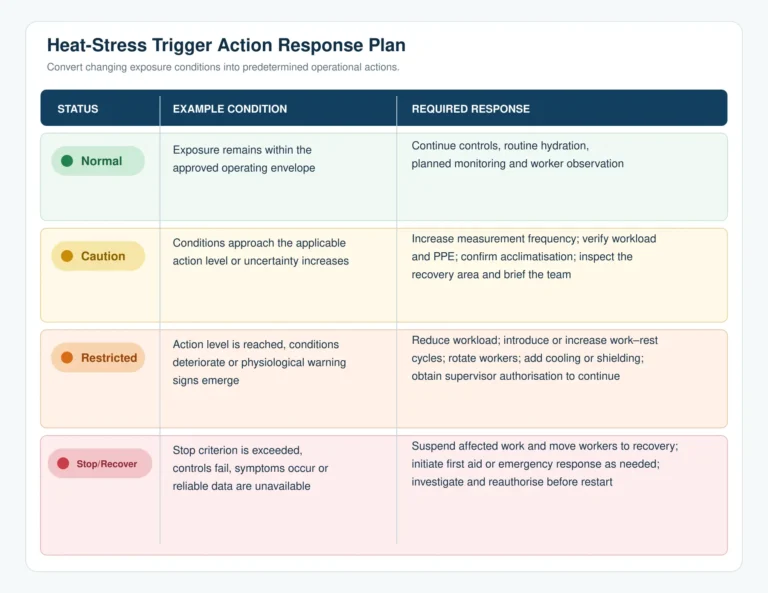
The actual trigger values must come from the organisation’s adopted standard, applicable law, risk profile and competent assessment. They must be adjusted for metabolic workload, clothing and acclimatisation where the selected framework requires it.
Most importantly, the plan should specify who has decision authority. A system fails when everyone receives an alert but nobody is accountable for changing the work.
Building a dynamic WBGT work rest schedule
A static schedule, such as 45 minutes of work followed by 15 minutes of rest can create false confidence. Exposure may change faster than the schedule.
A dynamic WBGT work-rest schedule should be recalculated or reviewed when any material input changes:
WBGT rises or radiant load changes;
workload becomes heavier;
workers enter a different zone;
PPE or clothing changes;
ventilation fails;
the recovery area’s temperature or cooling capacity deteriorates;
the task lasts longer than planned;
an unacclimatised worker joins the crew; or
symptoms, unusual fatigue or adverse physiological trends are reported.
Rest is also a control only when it permits recovery. A worker who stops exertion but remains beside the heat source, in full impermeable PPE, may not be receiving effective thermal recovery. The plan should define the rest location, shade or active cooling, PPE doffing rules, hydration access and minimum recovery conditions.
The operating logic can be expressed as a controlled cycle:
Measure: capture representative environmental conditions.
Characterise: verify workload, clothing, duration and worker status.
Compare: apply the selected standard and site trigger level.
Control: continue, modify, restrict or stop the task.
Verify: confirm that the intervention reduced exposure or strain.
Record: document the inputs, decision, authority and outcome.
Reassess: repeat when conditions or task parameters change.
This cycle converts WBGT from a displayed number into an operational control.
Integrating environmental sensors and physiological wearables
Connected WBGT instruments, fixed environmental sensors and physiological wearables can improve situational awareness. They may help reveal spatial hot spots, cumulative exposure, rising heart rate, skin-temperature trends or reduced recovery between work cycles.
However, more data does not automatically create a better decision.
Before deploying a device, the organisation should establish:
the variable being measured and its relationship to heat risk;
expected accuracy, operating range and response time;
calibration and functional-check requirements;
the effect of placement, movement, sweat, PPE and signal loss;
alert thresholds and required actions;
how false positives and false negatives will be investigated;
who receives the data and who is authorised to act;
data-retention, privacy and worker-consultation requirements; and
fallback controls when the device fails or connectivity is lost.
A wearable-generated alert should not be treated as a clinical diagnosis. Equally, the absence of an alert does not prove that exposure is safe. Devices and algorithms should be validated for the workforce, task and environment in which they will be used.
The strongest model combines environmental monitoring, task information, worker-reported symptoms and competent supervision. Technology should strengthen the control system, not replace professional judgement or the hierarchy of controls.
Managing sensor accuracy and false alerts
Heat-control decisions can be undermined in two ways: an instrument may fail to identify a dangerous exposure, or repeated nuisance alarms may cause workers and supervisors to ignore genuine warnings.
A defensible quality-assurance programme should include:
documented equipment selection criteria;
calibration traceability and scheduled servicing;
pre-use function and battery checks;
comparison between fixed and portable instruments where appropriate;
rules for sensor stabilisation and placement;
identification of missing, implausible or drifting data;
alarm-event review and corrective action;
version control for software and algorithms; and
a conservative fail-safe response when reliable readings are unavailable.
If a reading appears inconsistent with conditions, the response should not simply be to silence the alert. The team should verify the instrument, compare it with another measurement where available, inspect the work environment and maintain protective controls until the uncertainty is resolved.
Uncertainty is itself a risk factor.
Contractors and temporary workers cannot sit outside the system
Contractors often perform the most physically demanding work during shutdowns, turnarounds, construction projects and maintenance campaigns. They may also be unfamiliar with site heat sources, escalation routes and recovery facilities.
The host organisation should define minimum heat-stress requirements before mobilisation, including:
responsibility for exposure assessment and monitoring;
acclimatisation expectations;
approved workload and clothing classifications;
access to shade, cooling, drinking water and recovery areas;
training and language requirements;
stop-work authority;
medical and emergency-response arrangements;
reporting of symptoms and heat-related events; and
documentation that must be retained by the contractor and host.
Contractor performance should not be governed by a weaker threshold or a different interpretation of the same site conditions. Where multiple employers share a work area, the most conservative compatible control should prevail until roles and exposure conditions are clarified.
What makes a heat-stress decision legally and operationally defensible?
Defensibility does not mean proving that a model was perfect. It means demonstrating that the organisation used a competent, consistent and evidence-based process; responded to foreseeable risk; and recorded why the chosen action was reasonable at the time.
For each significant decision, the record should capture:
date, time, location and task;
environmental readings and instrument identification;
calibration or function-check status;
workload estimate and assessment method;
clothing and PPE configuration;
acclimatisation category or applicable protective assumption;
exposure duration and work–rest pattern;
relevant trigger level and adopted methodology;
symptoms, alerts or abnormal observations;
controls introduced and verification of their effectiveness;
name or role of the decision-maker;
reason for continuing, modifying or suspending work; and
time and conditions of the next reassessment.
These records support more than compliance. They allow the organisation to test whether its thresholds are working, identify recurring hot spots, investigate events and improve future task planning.
The decision rule: continue, modify or suspend
The final operational decision should consider four questions together:
1. Are the data reliable and representative?
If the sensor is out of calibration, poorly located or unrepresentative of the worker’s actual exposure, the organisation does not have a defensible basis for normal operation. Apply conservative controls until reliable information is available.
2. Is the exposure within the approved operating envelope?
Compare the adjusted WBGT or detailed assessment with the organisation’s adopted limits, taking account of workload, PPE, acclimatisation and exposure duration.
3. Are the controls functioning?
Ventilation, shielding, mechanisation, worker rotation, recovery areas and hydration arrangements must exist in practice not only in the procedure.
4. Is the worker showing signs of unacceptable strain?
Symptoms or concerning physiological trends require immediate attention even when the environmental result appears acceptable. Individual response can differ from modelled or group-based limits.
Work may continue only when the data are trustworthy, the exposure falls within the authorised envelope, the controls are verified and workers show no evidence of unacceptable strain.
Work should be modified when conditions approach or cross an action trigger but effective additional controls can restore an acceptable operating state.
Work should be suspended when a stop criterion is reached, controls are ineffective, symptoms occur, data integrity is lost or uncertainty cannot be resolved promptly.
From measurement to accountable control
An effective heat-stress programme does not ask a WBGT instrument to make the decision. It uses measurement within a governed system.
ISO 7243 can support field screening. ISO 8996 can strengthen the estimation of metabolic workload. ISO 7933 can provide deeper analysis where exposure is complex. Sensors and wearables can add timely evidence. But the organisation must still define thresholds, responsibilities, escalation rules, control verification and stop-work authority.
The most defensible system is therefore not the one with the largest dashboard or the greatest number of alerts. It is the one that can show a clear line from:
measurement → interpretation → control → verification → documented decision.
That is how environmental and physiological information becomes an operational decision to continue, modify or suspend work—and how a heat-stress programme moves from general guidance to engineered risk control.
Continue... the Conversation at Global HSE Nexus 3.0
Heat exposure, workforce health, fatigue, climate resilience and technology-enabled risk management will form part of the wider discussions at Global HSE Nexus 3.0, taking place on 28–29 April 2027 in Prague. If you are an industrial HSE, EHS, Operational Risk or Occupational Health professional, Click here to request the agenda or Register now as an Early Bird Delegate.
If your organisation provides HSE solutions, services or emerging technologies and you are preparing to launch or showcase a new innovation Global HSE Nexus 3.0 offers an opportunity to present it to an international community of HSE professionals from Europe, United States, United Kingdom, Türkiye, Middle East, Asia-Pacific and other global markets.
The audience is expected to include professionals from markets such as the Europe, United States, United Kingdom, TürkiyeUAE, Saudi Arabia, Oman, Qatar, Kuwait, India, China, Australia, Singapore, Malaysia and Indonesia.
Visit the Global HSE Nexus 3.0 page to request the agenda and explore how to become a Strategic Partner, showcase your solutions and support your next product or innovation launch.