
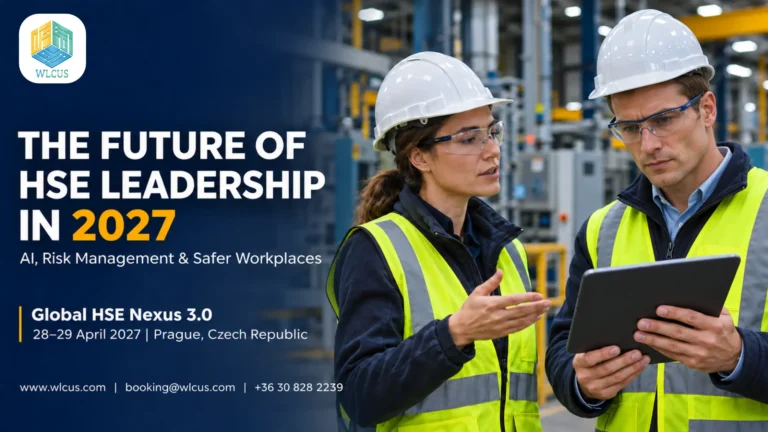
The Future of HSE Leadership in 2027: AI, Risk Management and Safer Workplaces
If someone on your team spotted a serious risk today, how quickly would your organisation act?
Would the concern reach the right person? Would there be time and resources to address it? Would the employee feel comfortable raising it in the first place?
These questions reveal a great deal about safety leadership.
HSE professionals understand the importance of policies, training and audits. They also know that work does not always happen exactly as planned. Equipment fails, contractors change, deadlines tighten and people make decisions under pressure.
The future of Health, Safety and Environment leadership depends on how well organisations understand these everyday conditions and respond to them.
As teams plan their 2027 priorities, these questions can help guide decisions about technology investment, workforce capability and operational preparedness. Five areas deserve particular attention: responsible AI adoption, serious injury and fatality prevention, integrated risk management, workforce resilience and preparation for disruption.
1. AI in Workplace Safety: Start with a Clear Purpose
Artificial intelligence is attracting attention across health and safety management. For HSE leaders, the starting point should be a specific operational problem.
Perhaps inspection findings take too long to review. Similar concerns appear across different sites without being connected. Teams collect information but struggle to identify where further investigation is needed.
AI and predictive analytics may help teams examine that information and recognise patterns. Their usefulness depends on the quality of the data, the suitability of the system and how people respond to its findings.
The European Agency for Safety and Health at Work explores these opportunities and challenges in its research on digitalisation and workplace safety, including overreliance on technology, human interaction with automated systems and psychosocial risks.
Before investing in AI for workplace safety, ask:
What hazard or operational problem are we addressing?
Does the system work reliably in our working environment?
How will we investigate false alerts and missed hazards?
Who will review findings and take action?
How will employees contribute to its evaluation?
An alert only becomes useful when someone understands it, checks it and takes appropriate action.
Successful AI integration requires a clear purpose, worker involvement and accountable human oversight.
2. Serious Injury and Fatality Prevention Begins with Everyday Work
Think about a job your organisation carries out regularly. It might involve maintenance, vehicle movements, lifting operations or work undertaken by contractors.
Now consider what happens when conditions change.
A supervisor is absent. The usual equipment is unavailable. Another contractor starts work nearby. The team feels pressure to finish before the next shift.
These are moments when leaders need visibility into how work is being managed.
A practical approach to serious injury and fatality prevention should examine the hazards with the greatest potential for harm, the controls intended to manage them and whether those controls remain effective as conditions change.
Useful questions include:
What could cause serious harm during this task?
Which controls must be in place before work begins?
How do we know those controls are working?
What changes would require the team to stop and reassess?
Can workers raise concerns and receive a timely response?
Learning from normal work also matters. Conversations with the people doing the job can reveal difficulties and gaps that are easy to miss in a formal report.
Make time to understand what helps people work safely and what makes that harder.
3. Integrated Risk Management Connects Safety with Business Decisions
Safety is influenced by decisions made throughout an organisation.
Procurement affects contractor selection. Operations influences schedules and workloads. Engineering determines equipment requirements. Finance helps decide which improvements receive funding.
Integrated risk management brings these perspectives together before decisions create problems on site.
Consider a maintenance shutdown. A shorter schedule might look attractive during planning, but the team also needs to examine staffing, simultaneous activities, supervision and the time required to complete work safely.
That conversation becomes more useful when HSE, operations, engineering and procurement participate early.
Where ISO Management Systems Fit
ISO 9001, ISO 14001 and ISO 45001 address quality, environmental management, and occupational health and safety respectively.
ISO explains how organisations can connect multiple standards through an integrated approach in its management-system standards guidance.
For organisations using these standards, integration offers a way to connect change management, auditing, corrective action and leadership review.
Each standard’s applicable edition and transition arrangements should be checked individually. The practical focus should be on what changes mean for people, responsibilities and operational controls.
A useful test is simple: Does your management system help people make better decisions when conditions change?
4. Workforce Resilience Starts with Listening
Ask a team what makes a difficult shift harder, and the answers may sound familiar: unclear instructions, insufficient resources, competing priorities or limited access to a supervisor.
These experiences deserve a place in HSE planning.
Workforce resilience means considering whether people have the capacity, competence and support to work safely over time. It includes staffing, workload, fatigue, occupational health and contractor capability.
Technology needs the same attention. Introducing a digital system should include an assessment of how it affects workload, autonomy and the experience of the people using it.
EU-OSHA’s research on AI-based worker management highlights the importance of worker participation and a human-centred approach.
Make Safety Communication Useful for Everyone
People bring different languages, experiences and levels of familiarity with a task. Training and communication should account for those differences.
A new employee may need more practical demonstration and supervision. An experienced worker may explain why a procedure is difficult to follow in real conditions.
Both perspectives are valuable.
Check understanding, invite questions and follow up on concerns.
Trust grows when employees can see that speaking up leads to a meaningful response.
5. Operational Resilience Requires Practice
What would happen if your site lost power during critical work? What if extreme weather reduced staffing or disrupted access? Who would decide whether operations could continue?
These questions are easier to explore before an emergency.
Scenario exercises allow teams to review responsibilities, communication and decision-making under pressure. They can also expose assumptions that have never been tested.
An exercise might examine:
How a disruption is recognised and escalated.
Who has authority to stop work.
How employees and contractors receive instructions.
What resources are needed to maintain safe conditions.
What must be verified before operations restart.
The discussion should produce practical actions, with named owners and follow-up dates.
Preparation becomes valuable when lessons lead to changes in how work is planned and managed.
Explore the Future of HSE Leadership at Global HSE Nexus 3.0 in Prague
These priorities are central to Global HSE Nexus 3.0, taking place on 28–29 April 2027 at Grandium Hotel Prague, Czech Republic.
The two-day HSE conference will explore the decisions connecting workplace safety, leadership and operational resilience.
Programme topics include:
Serious injury and fatality prevention.
Integrated risk leadership and the business case for prevention.
Contractor, supply-chain and workforce risk.
ISO management-system developments and assurance.
European HSE law and accountability.
AI, automation and predictive analytics.
Crisis response and operational disruption.
The programme includes a planned live crisis-room simulation, giving participants an opportunity to explore responses to challenging operational scenarios.
The published speaker line-up features professionals from Rolls-Royce, Siemens Healthineers, ŠKODA AUTO, Norsk Hydro, BASF and Sidel, alongside opportunities for executive discussions and business matchmaking.
For HSE directors, operations leaders, risk professionals and senior executives, the summit offers time to step back from daily demands, compare experiences with peers and consider what needs to change.
What is the one safety challenge you would most like to discuss with someone facing the same pressures?
Bring that question to Prague.
Explore Global HSE Nexus 3.0 and request the full agenda.
View delegate passes and register for 28–29 April 2027.
Speaker and Sponsorship partnership enquiries:
booking@wlcus.com | +36 30 828 2239