
EU HTA Joint Clinical Assessments (JCA):
The 7 Critical Mistakes Pharma Companies Must Avoid Before Their First Submission
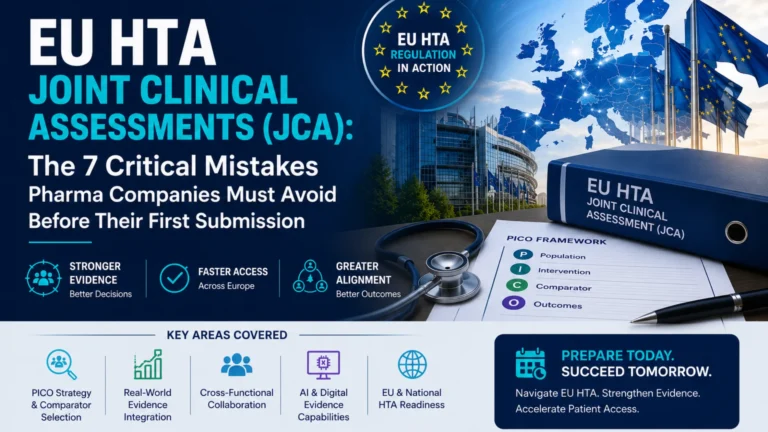
The European healthcare landscape is undergoing one of the most significant transformations in decades. With the implementation of the European Union Health Technology Assessment (EU HTA) Regulation and the introduction of Joint Clinical Assessments (JCA), pharmaceutical and biotechnology companies must rethink how they generate evidence, engage stakeholders, and prepare for market access across Europe.
For years, manufacturers have navigated multiple national HTA requirements, preparing different evidence packages for agencies such as NICE (United Kingdom), G-BA (Germany), HAS (France), AIFA (Italy), and other national authorities. The new EU HTA framework aims to harmonize clinical assessments across Member States, creating both opportunities and challenges for companies seeking faster and broader patient access.
While the promise of greater alignment is attractive, many organizations underestimate the complexity of JCA readiness. Early submissions are already revealing critical gaps in evidence planning, comparator selection, real-world evidence integration, and cross-functional collaboration.
This article explores the seven most common mistakes pharmaceutical and biotech companies must avoid before their first Joint Clinical Assessment submission.
Understanding the Importance of JCA
Joint Clinical Assessments are designed to provide a single clinical evaluation that can be used by multiple EU Member States during national pricing and reimbursement decisions.
The objective is to:
● Reduce duplication of clinical assessments across Europe
● Improve consistency in evidence evaluation
● Accelerate patient access to innovative therapies
● Increase transparency and predictability
● Strengthen evidence quality standards
However, while the clinical assessment may become more harmonized, pricing and reimbursement decisions will remain national responsibilities. This means manufacturers must prepare evidence that satisfies both EU-level requirements and country-specific expectations.
Mistake #1: Treating JCA as a Regulatory Exercise Instead of a Market Access Strategy
Many organizations continue to view JCA as merely another regulatory milestone.
This is a dangerous misconception.
JCA directly influences:
● Market access success
● Reimbursement outcomes
● Pricing negotiations
● Payer perceptions
● Launch sequencing strategies
Successful organizations are integrating JCA planning into their market access strategy years before submission rather than treating it as a final-stage regulatory activity.
Companies that fail to align regulatory, medical affairs, HEOR, and market access teams early often discover evidence gaps when it is too late to address them.
Mistake #2: Poor Comparator Selection
Comparator selection is rapidly emerging as one of the most critical elements of JCA readiness.
Historically, manufacturers could focus primarily on regulatory comparators used during clinical development. Under JCA, however, comparator expectations may vary significantly across European markets.
Common mistakes include:
● Selecting outdated standards of care
● Ignoring country-specific treatment pathways
● Failing to justify comparator choices
● Overlooking payer expectations
A weak comparator strategy can undermine the credibility of an entire submission.
Leading companies are now conducting comparator mapping exercises across major European markets during early development phases to ensure alignment between clinical and payer expectations.
Mistake #3: Waiting Too Long to Generate Real-World Evidence
Real-World Evidence (RWE) is becoming increasingly important in demonstrating comparative effectiveness, treatment patterns, healthcare resource utilization, and long-term outcomes.
Many companies still rely almost exclusively on randomized controlled trial data.
While RCTs remain the foundation of clinical evidence, decision-makers increasingly expect complementary evidence generated from real-world settings.
High-value RWE can help address:
● Evidence gaps
● External validity concerns
● Long-term effectiveness questions
● Rare disease challenges
● Subgroup analyses
Organizations that begin evidence generation only after pivotal trials are completed often find themselves struggling to meet payer and HTA expectations.
Mistake #4: Ignoring PICO Requirements Until Late Development
The PICO framework is central to Joint Clinical Assessments.
PICO evaluates:
● Population
● Intervention
● Comparator
● Outcomes
Many manufacturers underestimate how influential PICO requirements can become during evidence assessment.
Challenges frequently arise when:
● Trial populations do not align with real-world populations
● Key outcomes are missing
● Relevant comparators were not included
● Evidence generation plans fail to address payer priorities
Companies should incorporate anticipated PICO requirements during Phase II and Phase III development whenever possible. The earlier PICO considerations are integrated, the greater the likelihood of a successful submission.
Mistake #5: Failing to Build Cross-Functional Evidence Teams
Traditional organizational silos are incompatible with JCA success.
Many submissions suffer because different departments operate independently:
● Clinical Development
● Medical Affairs
● Regulatory Affairs
● Market Access
● HEOR
● RWE Teams
● Pricing & Reimbursement
Each function possesses critical information required for a robust evidence package.
Organizations achieving the strongest outcomes are creating integrated evidence planning teams that collaborate from development through commercialization.
Cross-functional governance structures improve:
● Evidence consistency
● Strategic alignment
● Submission quality
● Resource efficiency
Most importantly, they reduce the risk of discovering evidence gaps shortly before submission.
Mistake #6: Underestimating Country-Level Variations
One of the biggest myths surrounding EU HTA is that national differences will disappear. They will not.
Although clinical assessments may become more aligned, national authorities will continue to evaluate:
● Budget impact
● Affordability
● Healthcare system priorities
● Pricing considerations
● Local treatment pathways
Manufacturers must therefore balance EU-wide evidence generation with local market access requirements.
Companies that focus exclusively on JCA while neglecting country-specific strategies risk encountering significant reimbursement challenges after assessment completion.
Mistake #7: Delaying Digital and AI-Driven Evidence Capabilities
The volume and complexity of evidence required for modern market access continues to increase. Organizations relying solely on manual evidence management processes face significant disadvantages.
Advanced companies are increasingly leveraging:
● AI-assisted literature reviews
● Evidence synthesis platforms
● Predictive analytics
● Automated data quality monitoring
● Real-world evidence platforms
● Advanced HTA modelling tools
These technologies improve efficiency, reduce evidence generation timelines, and support more informed decision-making.
As EU HTA requirements evolve, digital evidence capabilities will become a competitive necessity rather than a technological advantage.
How Leading Organizations Are Preparing for JCA
Companies leading the way in JCA readiness share several common characteristics:
- Early Evidence Planning
Evidence generation begins years before submission. - Integrated RWE Strategies
Real-world evidence is embedded throughout development programs. - Cross-Functional Governance
Medical, regulatory, access, and HEOR teams collaborate continuously. - Digital Transformation
Evidence operations leverage advanced analytical and automation tools. - Proactive Stakeholder Engagement
Manufacturers seek early dialogue with relevant HTA stakeholders whenever possible.
The Future of Market Access in Europe
The introduction of Joint Clinical Assessments marks the beginning of a new era rather than the end of the market access journey.
Over the coming years, organizations will need to navigate:
● EU HTA implementation
● DARWIN EU expansion
● Increased use of real-world evidence
● AI-driven evidence generation
● Greater transparency requirements
● More sophisticated payer expectations
Success will increasingly depend on an organization’s ability to generate high-quality evidence that demonstrates clinical value, economic impact, and patient benefit across diverse healthcare systems.
Conclusion
The EU HTA framework represents one of the most important developments in European healthcare decision-making. For pharmaceutical and biotechnology companies, Joint Clinical Assessments create both opportunity and risk.
Organizations that invest early in evidence planning, comparator strategy, real-world evidence generation, PICO readiness, cross-functional collaboration, and digital capabilities will be best positioned to succeed.
The companies that wait until submission preparation begins may find themselves facing costly delays, evidence gaps, and challenging payer discussions.
The future of European market access belongs to organizations that view JCA not as a compliance requirement, but as a strategic opportunity to strengthen evidence, accelerate access, and improve patient outcomes across Europe.
Avoiding these seven critical submission blunders requires more than just internal policy changes, it demands a complete evolution in how your teams collaborate, synthesize evidence, and leverage digital tools. The blueprint for mastering this shift is exactly what we will be unlocking live at the European RWE & Market Access Summit 2026 in Amsterdam. This isn’t just another industry conference; it is an interactive sandbox designed to break down the traditional corporate silos between clinical, regulatory, HEOR, and market access teams. By joining Europe’s leading minds, you will gain hands-on insights into harmonizing your PICO strategies, accelerating your RWE timelines, and aligning your cross-functional operations into a perfectly synchronized, audit-proof engine. Don’t leave your first JCA submission to guesswork. Secure your seat today to transform your market access strategy, align your workflows with modern EU HTA standards, and ensure your innovative therapies reach patients without delay.