
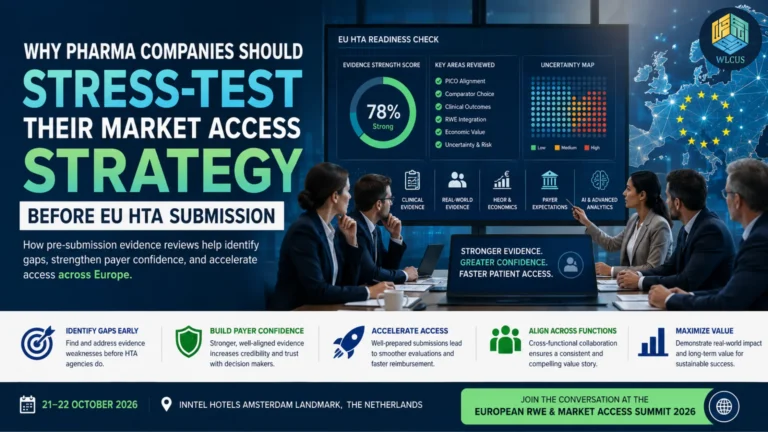
How pre-submission evidence reviews are becoming the next competitive advantage for pharmaceutical and biotech companies in Europe.
The pharmaceutical industry has entered a new era of evidence generation.
For years, achieving regulatory approval was considered the biggest milestone on the path to commercialization. Once a medicine demonstrated safety and efficacy, companies could focus on pricing negotiations and reimbursement discussions in individual countries.
Today, that approach is no longer enough.
The introduction of the European Union Health Technology Assessment (EU HTA) Regulation has fundamentally changed how pharmaceutical and biotech companies prepare for market access across Europe. Evidence packages are now being scrutinized more rigorously than ever before, with a stronger emphasis on comparative clinical effectiveness, patient relevance, real-world evidence (RWE), and transparent clinical reasoning.
As a result, many leading pharmaceutical organizations are adopting a new strategy before submitting their dossiers to regulators and HTA agencies.
They are stress-testing their Market Access strategy before submission.
Instead of waiting for HTA agencies to identify weaknesses, companies are proactively challenging their own evidence, assumptions, and value propositions to ensure they are prepared for the toughest questions regulators and payers may ask.
This shift is quietly becoming one of the most important competitive advantages in pharmaceutical market access.
Why Strong Clinical Data Alone Is No Longer Enough
A medicine can achieve excellent clinical trial results yet still encounter significant challenges during reimbursement discussions.
This often surprises development teams.
The issue is rarely the quality of the science.
Instead, questions typically arise around whether the evidence answers the questions that matter most to HTA bodies, healthcare payers, and decision-makers responsible for allocating healthcare budgets.
These stakeholders increasingly ask:
- Was the right comparator selected?
- Does the evidence reflect routine clinical practice?
- Are patient-reported outcomes meaningful?
- How applicable are the trial results to the local healthcare system?
- What uncertainties remain regarding long-term effectiveness?
- Does the evidence demonstrate sufficient value compared with existing therapies?
These questions can significantly influence reimbursement outcomes, regardless of how successful the clinical trial itself may have been.
The European Commission’s implementation of Joint Clinical Assessments (JCA) reinforces this trend by promoting a common assessment of clinical evidence that can inform reimbursement decisions across multiple Member States.
The Shift from Regulatory Success to Market Access Success
Historically, pharmaceutical development followed a relatively linear process.
Clinical Development
↓
Regulatory Approval
↓
Market Access
↓
Commercial Launch
Today, these functions are becoming increasingly integrated.
Market Access teams are involved much earlier in development, often participating in:
- Clinical development planning
- Endpoint selection
- Comparator strategy
- PICO framework discussions
- Evidence generation planning
- Real-World Evidence strategy
- HEOR planning
- Value dossier development
The objective is no longer simply obtaining regulatory approval.
The objective is ensuring that the available evidence can withstand scrutiny from regulators, HTA agencies, and healthcare payers simultaneously.
What Does "Stress-Testing" a Market Access Strategy Mean?
Think of it as conducting a full rehearsal before an important examination.
Before submitting an HTA dossier, cross-functional teams critically evaluate every component of the evidence package from the perspective of external assessors.
Instead of asking:
“Do we believe our product demonstrates value?”
They ask:
“How would an HTA committee challenge our conclusions?”
This subtle difference changes the entire preparation process.
The review typically involves collaboration between:
- Market Access
- HEOR
- Medical Affairs
- Clinical Development
- Biostatistics
- Epidemiology
- Regulatory Affairs
- Commercial Strategy
- Pricing Teams
- External HTA experts
Together, these experts examine whether the evidence package is sufficiently robust to answer the questions likely to arise during assessment.
The Questions Every Evidence Package Should Be Able to Answer
One of the most valuable aspects of pre-submission stress testing is its ability to uncover unanswered questions before external reviewers identify them.
Some of the most common questions include:
Is the comparator appropriate?
Comparator selection remains one of the most debated elements of HTA submissions.
A comparator accepted during clinical development may not reflect standard clinical practice in every European healthcare system.
If the comparator does not align with payer expectations, the overall assessment may become more uncertain.
Does the evidence answer the agreed PICO?
Under EU HTA, evidence is increasingly evaluated against predefined Population, Intervention, Comparator and Outcomes (PICO) requirements.
Companies must ensure that their clinical evidence aligns closely with these expectations rather than assuming broad applicability.
Are patient outcomes clinically meaningful?
Statistical significance alone rarely determines reimbursement success.
Decision-makers increasingly evaluate:
- Overall survival
- Quality of life
- Functional improvement
- Long-term outcomes
- Patient-reported outcomes
- Disease burden reduction
The stronger the connection between evidence and meaningful patient benefit, the stronger the value proposition becomes.
Where Does Real-World Evidence Strengthen the Submission?
Randomized clinical trials (RCTs) remain the foundation of clinical evidence generation and are essential for demonstrating the safety and efficacy of new medicines.
However, RCTs cannot answer every question relevant to healthcare payers, HTA bodies, and clinical decision-makers.
Real-World Evidence (RWE) complements clinical trial data by providing valuable insights into:
- Treatment patterns in routine clinical practice
- Long-term effectiveness and safety
- Healthcare resource utilization
- Patient adherence and persistence
- Outcomes across broader and more diverse patient populations
When integrated appropriately, RWE can help address evidence gaps, reduce uncertainty, and strengthen the overall value proposition submitted to HTA agencies.
As highlighted in the Journal of Market Access & Health Policy, the role of Real-World Evidence in Health Technology Assessment continues to expand, particularly in supporting comparative effectiveness assessments, addressing evidence uncertainties, and informing reimbursement decisions across evolving healthcare systems.
What uncertainties remain?
Every submission contains uncertainty.
Successful organizations identify these uncertainties themselves rather than waiting for assessors to highlight them.
Questions often include:
- Are subgroup analyses sufficiently robust?
- Are follow-up periods long enough?
- Are indirect comparisons reliable?
- Are assumptions clearly justified?
- Could alternative interpretations exist?
Acknowledging uncertainty, and explaining how it is managed often strengthens credibility.
Why Cross-Functional Collaboration Matters More Than Ever
One of the biggest lessons emerging from modern Market Access strategy is that no single department owns the evidence.
Clinical Development generates data.
Medical Affairs interprets scientific value.
HEOR demonstrates economic impact.
Market Access translates evidence into payer value.
Regulatory Affairs ensures compliance.
Commercial teams understand market dynamics.
When these functions work independently, important evidence gaps often remain undiscovered until late in the submission process.
Organizations that integrate these teams earlier are better positioned to develop coherent, consistent, and payer-focused evidence strategies.
The Growing Role of Artificial Intelligence
Artificial Intelligence is also changing how pharmaceutical companies prepare for Market Access.
While AI cannot replace scientific expertise or HTA decision-making, it is becoming an increasingly valuable decision-support tool.
Organizations are exploring AI to:
- Identify evidence gaps across clinical programs
- Analyze historical HTA decisions
- Review published literature at scale
- Detect inconsistencies in evidence packages
- Support systematic literature reviews
- Summarize competitor evidence strategies
- Improve evidence synthesis
- Prioritize additional analyses
Rather than replacing experts, AI enables teams to focus more time on strategic decision-making and less time on repetitive evidence review.
Why This Matters Even More Under EU HTA
The EU HTA Regulation represents one of the most significant changes to European Market Access in decades.
Although pricing and reimbursement decisions remain national responsibilities, Joint Clinical Assessments introduce a shared evaluation of clinical evidence that multiple Member States can consider.
This means that weaknesses in evidence may have broader implications than before.
Companies can no longer prepare submissions solely with one national HTA body in mind.
Evidence strategies increasingly need to support broader European expectations while remaining flexible enough to address country-specific reimbursement requirements.
Preparation therefore begins much earlier than it did historically.
Characteristics of Organizations Leading the Way
Across the industry, organizations demonstrating strong Market Access performance often share several characteristics.
They:
Begin Market Access planning during clinical development.
Develop evidence strategies collaboratively across functions.
Integrate Real-World Evidence into development plans where appropriate.
Continuously review evolving HTA expectations.
Challenge their own evidence before external review.
Use technology and analytics to improve evidence quality.
Focus on reducing uncertainty rather than simply increasing data volume.
These practices are becoming hallmarks of evidence-driven organizations.
Looking Ahead: From Evidence Generation to Evidence Confidence
Generating evidence has never been the ultimate objective.
The real objective is generating evidence that decision-makers trust.
As healthcare systems face increasing financial pressures and demand stronger demonstrations of value, confidence in evidence becomes just as important as the evidence itself.
Organizations that proactively evaluate their evidence from the perspective of HTA agencies, payers, clinicians, and patients are more likely to navigate complex reimbursement environments successfully.
The future of pharmaceutical Market Access will not belong to companies that simply generate more data.
It will belong to organizations that generate the right evidence, anticipate the toughest questions, and build confidence before submission.
Stress-testing a Market Access strategy is therefore more than a quality assurance exercise.
It is becoming an essential component of successful commercialization in the era of EU HTA.
Final Thoughts
The pharmaceutical industry is evolving rapidly.
Scientific innovation alone is no longer enough to guarantee commercial success.
In an increasingly evidence-driven healthcare environment, organizations must ensure that every piece of clinical, economic, and real-world evidence contributes to a compelling value story.
By identifying weaknesses early, encouraging cross-functional collaboration, integrating Real-World Evidence strategically, and aligning evidence with payer expectations, pharmaceutical and biopharma companies can significantly strengthen their readiness for EU HTA and national reimbursement discussions.
Those who invest in rigorous pre-submission preparation today will be better positioned to achieve faster market access, greater payer confidence, and improved patient access tomorrow.
Join the Conversation in Amsterdam
The European RWE & Market Access Summit 2026, taking place on 21–22 October 2026 at Inntel Hotels Amsterdam Landmark, will bring together senior leaders from pharmaceutical, biotechnology, HTA bodies, healthcare organizations, and solution providers to discuss the latest developments in EU HTA, Joint Clinical Assessments (JCA), PICO Strategy, Real-World Evidence, HEOR, Pricing & Reimbursement, and AI-powered evidence generation.
Whether you are preparing for EU HTA submissions, strengthening your evidence strategy, or exploring innovative approaches to Market Access, the summit offers an opportunity to learn from industry experts, share best practices, and build valuable collaborations.