

The European pharmaceutical market access landscape is entering a new phase. With the implementation of the European Union Health Technology Assessment (EU HTA) Regulation, Joint Clinical Assessments (JCA) are becoming an integral part of evidence planning for eligible medicines across Europe.
As mandatory Joint Clinical Assessments (JCA) kick into gear for all oncology treatments and Advanced Therapy Medicinal Products (ATMPs), biopharma companies face an intense, unyielding reality: a strict 100-day submission window.
For Market Access Directors, HEOR leaders, and evidence generation specialists, this regulatory shift has introduced a new challenge that many teams describe as “PICO anxiety.” As Member States continue to define populations, interventions, comparators, and outcomes differently, pharmaceutical companies must prepare for increasing complexity in evidence planning, launch readiness, and national reimbursement strategies across Europe.
To navigate this evolving landscape, cross-functional teams must move past theoretical compliance and master the architecture of regulatory-grade Real-World Evidence (RWE).
What is Driving 'PICO Anxiety' in 2026?
The core challenge of the JCA process boils down to the formulation of the PICO framework:
● Population (Which patient subgroups are being evaluated?)
● Intervention (The medicine under review)
● Comparator (What existing therapy is it being measured against?)
● Outcome (The clinical and real-world endpoints)
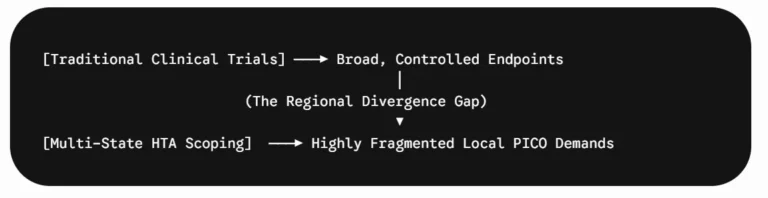
Because individual EU member states maintain distinct standard-of-care baselines, a comparator drug accepted in Germany might be completely dismissed by an HTA body in France or Spain. Biopharma companies are forced to anticipate dozens of localized PICO scoping variations simultaneously.
If your statistical models fail to align with a specific country’s local payer priorities, your drug faces devastating delays in pricing and reimbursement negotiations, effectively locking patients out of life-saving therapies.
The Strategic Solution: Leveraging DARWIN EU 2.0 and AI Evidence Synthesis
To proactively mitigate selection bias and bridge the gap between static clinical trials and diverse multi-state requirements, pharma solution providers are leaning heavily on standardized data networks.
The European Medicines Agency’s (EMA) DARWIN EU initiative is supporting the use of real-world data to strengthen evidence generation for regulatory decision-making across Europe. At the same time, pharmaceutical companies and solution providers are increasingly exploring AI-enabled evidence synthesis and interoperable data platforms to improve efficiency, support evidence planning, and reduce uncertainty during market access and HTA submissions.
By shifting from broad, generalized data pools to precision, country-specific real-world data (RWD), forward-thinking manufacturers can eliminate statistical surprises well before the 100-day submission countdown begins.
Building Your Strategy: The Actionable Blueprint
Navigating national HTA readiness requires breaking down the traditional silos between clinical development, regulatory affairs, and commercial strategy.
Run predictive analytics to simulate how different EU member states will formulate their PICO demands based on historical local reimbursement behaviors.
Structure your RWE strategy around DARWIN EU standards to ensure data packages carry the necessary scientific integrity required by cross-border HTA reviewers.
Utilize commercial AI tools to compress the “data-to-submission” lifecycle, giving your rapid-response teams a cushion during the frantic 100-day JCA phase.
Entering the Implementation War Room: Amsterdam 2026
Successfully navigating the evolving European HTA landscape requires collaboration, practical knowledge sharing, and open dialogue between pharmaceutical companies, HTA experts, payer organisations, regulators, academia, and solution providers.
On 21–22 October 2026, the European RWE & Market Access Summit – JCA & PICO Strategy Edition will take place in Amsterdam, bringing together senior professionals from across the pharmaceutical and healthcare ecosystem to discuss the latest developments in Real-World Evidence, Market Access, EU HTA, and Pricing & Reimbursement.
Organised by WLCUS, the summit is designed to provide practical insights into EU HTA implementation, PICO strategy, evidence generation, and market access planning. Through case studies, panel discussions, and expert presentations from pharmaceutical companies, HTA experts, payer organisations, and solution providers, delegates will explore practical approaches to addressing today’s evidence and reimbursement challenges.
Key Summit Tracks You Can't Afford to Miss:
● JCA Submission Mastery: Practical roadmaps for oncology and ATMP dossiers under aggressive timelines.
● Bias Mitigation & Statistical Alignment: Overcoming regional divergence in comparator definitions.
● DARWIN EU 2.0 Operations: Direct technical briefings on multi-state data interoperability.
● Payer & Regulator Closed-Door Networking: Engaging directly with HTA assessors and policy makers to accurately gauge local payer sentiment
Market Access & JCA FAQ
What is the timeline for mandatory JCA oncology dossiers?
Under the current European HTA regulation, biopharma manufacturers have a strict 100-day submission window to deliver comprehensive clinical data packages once the JCA process is formally initiated.
How does RWE mitigate selection bias in HTA submissions?
Real-World Evidence (RWE) fills the evidence gaps left by randomized controlled trials (RCTs) by providing localized, population-level health data. By utilizing rigorous statistical matching and predictive frameworks, manufacturers can align their clinical endpoints with country-specific comparators.
What is the primary role of AI in HEOR evidence synthesis?
AI and machine learning streamline HEOR (Health Economics and Outcomes Research) workflows by accelerating data mining across fragmented health registries. This radically compresses the time it takes to synthesize raw real-world data into submission-ready evidence.
Conclusion
The implementation of the EU HTA framework is reshaping how pharmaceutical companies approach evidence generation, market access, and reimbursement planning across Europe. As organisations adapt to Joint Clinical Assessments and evolving PICO requirements, early collaboration, integrated evidence strategies, and high-quality Real-World Evidence are becoming increasingly important for supporting informed decision-making and timely patient access.
While every organisation’s approach will differ, those that align Clinical Development, Medical Affairs, HEOR, and Market Access teams from an early stage are likely to be better prepared for the evolving European landscape.
The topics discussed in this article, including PICO strategy, Joint Clinical Assessments, Real-World Evidence, AI-enabled evidence generation, and market access planning, will be explored by senior professionals from pharmaceutical companies, HTA bodies, payer organisations, regulators, academia, and solution providers at the
European RWE & Market Access Summit – JCA & PICO Strategy Edition.
21-22 October 2026,
Amsterdam, Netherlands
Request the Agenda here : European RWE & Market Access Summit 2026 Join us in Amsterdam