
Europe's 3,367 Workplace Deaths:
Why Safety Leadership Must Change in 2027
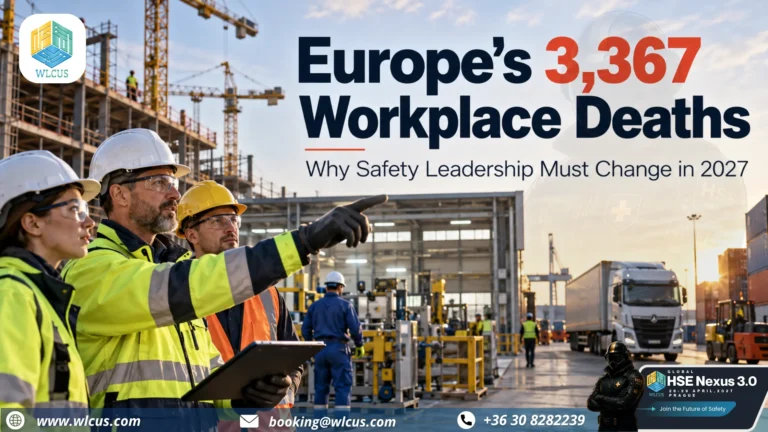
New Eurostat figures reveal a concerning contrast: workplace fatalities increased across the European Union even as reported non-fatal accidents declined. For HSE leaders, the question is no longer simply whether safety programmes are working, but whether organisations are effectively controlling risks capable of taking lives.
3,367 Lives Lost: What Europe's Latest Workplace Safety Statistics Reveal
In 2024, 3,367 people died in workplace accidents across the European Union, according to the latest Eurostat figures published on 25 September 2026.
This represents a 1.4% increase compared with 2023, equivalent to 45 additional deaths.
Over the same period, the EU recorded approximately 2.78 million non-fatal workplace accidents, a decrease of 1.5%. These figures cover accidents resulting in at least four full calendar days of absence from work. The statistics relate to the 27 European Union member states in 2024 and were published by Eurostat in September 2026.
These numbers present a difficult but important question for today’s industrial leaders:
If reported non-fatal workplace accidents are decreasing, why are thousands of workers still losing their lives?
The figures do not necessarily demonstrate that existing safety management systems are failing. However, they highlight why improvements in overall injury rates should not automatically be interpreted as equivalent progress in preventing fatal or life-changing incidents.
For organisations operating in construction, manufacturing, energy, logistics and other high-risk industries, the statistics provide an important reason to reassess critical-risk management, operational accountability and prevention strategies.
Source: Eurostat – Accidents at Work Claimed 3,367 Lives in the EU in 2024.
Which Industries Recorded the Highest Workplace Fatalities in Europe?
Eurostat’s latest published data identifies three industries accounting for a substantial proportion of fatal workplace accidents in the EU.
| Industry | Fatal workplace accidents in 2024 |
|---|---|
| Construction | 776 |
| Transportation and Storage | 537 |
| Manufacturing | 466 |
| Combined | 1,779 |
Together, these sectors accounted for approximately 53% of recorded EU workplace fatalities.
These are absolute numbers and should not be interpreted as industry fatality rates adjusted for workforce size or hours worked.
Nevertheless, they demonstrate the continuing scale of the challenge facing Europe’s industrial economy.
Construction: Managing High-Consequence Hazards
Construction environments often involve changing working conditions, temporary structures, multiple contractors and complex equipment interactions.
Falls from height, lifting operations, moving machinery, excavations and hazardous energy are examples of risks that can result in fatal outcomes.
For construction executives, the central challenge is not merely developing safety procedures, but demonstrating that essential controls remain effective throughout changing project conditions.
Transportation and Logistics: Risk Beyond the Workplace Boundary
Transportation and storage recorded 537 fatal workplace accidents in the EU in 2024.
Organisations must consider risk across loading operations, warehousing, vehicle movements, maintenance activities and work conducted away from fixed facilities.
Fatigue, contractor coordination, vehicle safety and operational pressures require systematic management.
Manufacturing: Looking Beyond Injury Statistics
Manufacturing recorded 466 fatal accidents and 509,851 non-fatal workplace accidents in 2024.
Machinery, maintenance, equipment isolation, automation and human-machine interaction are important areas for critical-risk management.
As manufacturing becomes increasingly digitalised, organisations need to ensure that safety processes, technical controls and workforce capabilities evolve together.
Why Low Injury Rates Do Not Always Mean Low Fatality Risk
Many organisations assess their safety performance using indicators such as:
Lost Time Injury Frequency Rate (LTIFR)
Total Recordable Incident Rate (TRIR)
Days without a recordable accident
Safety inspection results
Training completion rates
These indicators remain useful for monitoring different aspects of workplace safety.
However, they cannot independently establish whether the organisation has effectively controlled its most serious hazards.
An industrial facility may report a sustained reduction in minor injuries while weaknesses remain in equipment isolation, process safety or maintenance procedures.
Similarly, a construction organisation may achieve high compliance scores without consistently verifying critical safeguards during complex operations.
The absence of recent accidents is not proof that high-consequence hazards are under control.
This distinction is essential to Serious Injury and Fatality prevention.
What Is SIF Prevention?
Serious Injury and Fatality (SIF) prevention is a targeted approach to identifying and controlling hazards that could result in fatal or life-changing harm.
It prioritises potential severity, exposure to critical risks and the reliability of controls designed to prevent catastrophic outcomes.
Rather than relying exclusively on past incident frequency, SIF prevention asks whether existing safeguards are sufficient to prevent the next serious event.
Effective prevention requires organisations to understand what could go wrong, how severe the outcome might be and whether essential protections are functioning in practice.
Five Leadership Changes That Could Strengthen Workplace Safety in 2027
1. Move From Compliance Reporting to Critical-Risk Visibility
Regulatory compliance remains fundamental to workplace safety.
However, completing inspections, checklists and mandatory documentation does not necessarily guarantee that high-risk activities are being controlled effectively.
HSE leaders increasingly need a clearer understanding of operational exposure.
Key questions include:
Which activities have the greatest potential for serious injury or fatality?
What critical controls are required to prevent these outcomes?
How are those controls verified in actual working conditions?
Who has authority to stop work when safeguards are missing?
How quickly can emerging risks be escalated and addressed?
The objective should be evidence of effective risk control, not simply evidence that safety documentation has been completed.
This may require stronger operational assurance, frontline engagement and coordination between safety, engineering and operations teams.
2. Bring HSE Into Strategic Business Decisions
Safety performance is influenced by decisions made far beyond the HSE department.
Maintenance investment, production targets, staffing levels, contractor selection and capital allocation can all affect operational risk.
For example, postponing maintenance may create short-term financial savings while increasing exposure to equipment deterioration or unexpected failure.
Reducing workforce capacity without carefully evaluating operational requirements may introduce fatigue, supervision and competency challenges.
This creates a fundamental leadership question:
Are organisations assessing the safety consequences of commercial and operational decisions before those decisions are implemented?
Modern HSE leadership should connect prevention with enterprise risk management, operational reliability and sustainable business performance.
Safety is not separate from business strategy. It is one of the foundations of resilient operations.
3.Learn From Normal Work Not Only From Accidents
Incident investigations provide valuable lessons, but organisations should not depend exclusively on accidents to identify weaknesses.
Everyday work can reveal important information about how systems operate under real conditions.
Workers frequently adapt to changing production demands, equipment limitations, unexpected site conditions and competing operational priorities.
Understanding these adaptations can help organisations identify weaknesses before they contribute to serious incidents.
Areas worth examining include:
Differences between documented procedures and actual work
Difficulties applying safety controls
Communication gaps during shift changes
Repeated operational workarounds
Unresolved near-misses and high-potential events
Situations where workers feel unable to raise concerns
Psychological safety can support this learning process by creating conditions in which employees can report risks and question decisions without inappropriate blame.
However, encouraging workers to speak up is only meaningful when management responds effectively.
A strong safety culture is not defined only by how frequently people report concerns, but by how consistently the organisation learns and acts on them.
4. Use AI and Predictive Analytics With Clear Accountability
Artificial Intelligence is opening new possibilities for industrial safety.
Organisations are exploring technologies capable of analysing equipment conditions, identifying potential hazards and supporting earlier intervention.
Potential applications include:
Predictive maintenance: Using equipment data to identify deterioration and improve maintenance planning.
Computer vision: Detecting specified hazardous conditions and interactions between workers and machinery.
Connected-worker technology: Supporting communication, exposure monitoring and emergency response.
Predictive safety analytics: Identifying patterns in operational information that may warrant additional risk assessment.
These technologies may improve hazard visibility and support better decisions.
However, implementation must be approached carefully.
False alerts, missed detections, incomplete datasets, worker privacy concerns and overreliance on automation can undermine confidence and introduce new risks.
Before adopting AI-enabled safety solutions, organisations should establish clear answers to five questions:
What specific operational risk is the technology intended to reduce?
Has it been adequately validated for the intended environment?
Who is responsible for interpreting and acting on its outputs?
How are data quality, false alerts and system limitations managed?
What measurable evidence will demonstrate improved safety performance?
Organisations exploring these technologies can also read WLCUS’s analysis of Agentic AI, Digital Twins and SIF Prevention.
The success of AI in HSE should be measured through demonstrable improvements in risk management, not simply the number of technologies deployed.
5. Treat Contractor Safety as a Shared Operational Responsibility
Complex industrial operations frequently involve contractors, subcontractors and specialist service providers.
These arrangements can create additional challenges involving supervision, competence, simultaneous operations and unclear responsibilities.
Effective contractor safety management must extend beyond procurement-stage qualification and contractual requirements.
Organisations should establish robust processes for:
Contractor competency verification
Critical-risk assessments
Permit-to-work systems
Hazardous energy isolation
Coordination between supervisors
Management of simultaneous operations
Incident learning and corrective actions
The responsibility for operational safety cannot be managed effectively through contractual arrangements alone.
The essential question is whether every party understands the risks, the necessary safeguards and its responsibility for controlling them.
What Should HSE Leaders Measure Beyond Traditional Safety KPIs?
There is no single metric capable of predicting every serious workplace accident.
However, organisations can strengthen safety performance monitoring by combining conventional indicators with information about high-consequence exposure and critical-control effectiveness.
| Traditional Safety Indicator | Additional Critical-Risk Measurement |
|---|---|
| Lost Time Injury Frequency Rate | Exposure to activities with SIF potential |
| Training completion | Demonstrated safety-critical competence |
| Number of safety inspections | Effectiveness of critical-control verification |
| Total near-misses reported | High-potential events and learning quality |
| Corrective actions completed | Verified effectiveness of corrective actions |
| Audit completion rate | Reliability of safety-critical barriers |
| Safety observations | Unresolved high-consequence hazards |
These measures should be adapted to the organisation’s specific risks, evaluated consistently and supported by frontline operational information.
An increase in reported concerns, for example, may reflect deteriorating conditions, stronger reporting practices or both.
Leaders must understand the context before drawing conclusions.
The purpose of measurement is not simply to produce better statistics, but to provide better information for preventing harm.
The Business Case for Safety: Why CFOs and COOs Must Pay Attention
Serious workplace incidents can generate significant consequences beyond direct injury-related costs.
Potential impacts include:
Production shutdowns and business interruption
Equipment and infrastructure damage
Regulatory investigations and legal costs
Project delays and contractual disruption
Loss of experienced employees
Reputational consequences
Reduced operational confidence and workforce morale
The costs and probabilities of these outcomes may be uncertain, but that does not make them irrelevant to business planning.
HSE leaders can strengthen investment proposals by demonstrating how preventive measures influence risk exposure, operational continuity and long-term organisational performance.
A credible business case should address four questions:
What could happen? Identify reasonably foreseeable high-consequence scenarios.
What is currently preventing it? Evaluate existing safeguards and their reliability.
What improvement is proposed? Explain how an investment could reduce exposure or strengthen prevention.
How will success be demonstrated? Establish measurable evidence of control effectiveness and operational outcomes.
This creates an opportunity for HSE professionals to communicate more effectively with Finance, Operations and executive leadership.
Safety investment should not be evaluated only through the immediate cost of implementation.
It should also be considered in relation to the organisation’s exposure to serious operational loss.
Operational Resilience: The Next Priority for HSE Leadership
European industrial organisations face interconnected challenges involving workforce capacity, digital transformation, changing operational conditions, contractor dependencies and climate-related disruption.
Managing these challenges requires coordination across safety, operations, risk management, sustainability and technology.
A resilient organisation must be capable of identifying emerging threats, maintaining effective safeguards, adapting to unexpected conditions and recovering from disruption.
This changes the role of HSE leadership.
Instead of focusing only on compliance and incident reporting, HSE leaders increasingly contribute to decisions affecting business continuity, workforce capability, asset reliability and long-term operational performance.
Three priorities should remain central:
Protect People: Identify and control hazards with potentially serious or fatal consequences.
Strengthen Operations: Develop reliable systems, capable teams and effective risk-management processes.
Create Strategic Value: Incorporate prevention into executive decisions, investment planning and organisational resilience.
The challenge for 2027 is translating these priorities into practical action.
Where Will the Future of HSE Leadership Be Decided?
The next phase of workplace safety will require more than new policies, additional dashboards or isolated technological improvements.
It will demand stronger leadership, collaboration and new ways of understanding how risk develops across complex industrial operations.
But what will leading organisations actually do differently in 2027?
How will executives connect safety with financial performance? Which emerging technologies can deliver measurable improvements? And what changes will be required to create safer, more resilient industrial workplaces?
These are among the wider challenges shaping conversations across the international HSE community.
Following its previous edition in Berlin, Global HSE Nexus 3.0 will bring international leaders and professionals from Health, Safety, Environment, Operations, Risk, Sustainability and Technology together in Prague, Czech Republic.
Under the theme “Integrated Risk. Resilient Operations. Strategic Value.”, the Summit will provide an international platform for executive insight, industry perspectives, practical learning and strategic networking.
The developing programme brings together discussions on some of the most pressing issues shaping the future of industrial safety and business resilience.
Which leadership priorities, practical approaches and emerging solutions will define the next chapter of HSE?
Discover the full programme, speaker perspectives and partnership opportunities by requesting the official Summit agenda.
Request the Global HSE Nexus 3.0 Agenda
Request Agenda: Click here
Delegate Registration: Click here
Sponsorship request: Click here
Email: booking@wlcus.com
Website: www.wlcus.com
Tel: +36 30 828 2239
Interested in speaking, exhibiting or becoming a strategic partner? Contact the WLCUS team to explore how your organisation can engage with senior industrial HSE and operational decision-makers.
Frequently Asked Questions
How many workplace fatalities were recorded in Europe?
According to Eurostat, the European Union recorded 3,367 fatal workplace accidents in 2024. The figures were published on 25 September 2026 and represent an increase of 1.4% compared with 2023.
Which industries recorded the highest workplace fatalities in the EU?
In 2024, construction recorded 776 fatal workplace accidents, transportation and storage recorded 537, and manufacturing recorded 466. These numbers reflect the total number of recorded fatal accidents rather than risk rates adjusted for sector size.
What is Serious Injury and Fatality (SIF) prevention?
SIF prevention focuses on identifying high-consequence hazards, understanding exposure to serious risks and ensuring effective controls are in place to prevent fatal or life-changing injuries.
Why are low accident rates not enough to measure workplace safety?
Traditional injury indicators help organisations monitor safety performance but do not independently demonstrate whether critical controls are effective against low-frequency, high-severity events. Additional risk-based measures are necessary.
Can artificial intelligence prevent workplace accidents?
AI can support hazard identification, predictive maintenance, safety monitoring and risk analysis. However, its effectiveness depends on data quality, validation, operational conditions, human oversight and appropriate safeguards. AI cannot guarantee accident prevention.
What should industrial companies prioritise for workplace safety in 2027?
Priorities include stronger critical-risk management, reliable control verification, contractor coordination, operational learning, responsible technology adoption and greater integration between HSE and executive decision-making.
What is Global HSE Nexus 3.0?
Global HSE Nexus 3.0 is an international Health, Safety, Environment and operational risk leadership summit taking place on 28–29 April 2027 in Prague, Czech Republic. The event will focus on strengthening collaboration between safety, operational resilience and strategic business leadership.
How can I request the Global HSE Nexus 3.0 agenda?
Delegates, speakers, and prospective sponsors are invited to request the latest Global HSE Nexus 3.0 Summit agenda by visiting the Global HSE Nexus 3.0 webpage.. or contacting the WLCUS team directly at booking@wlcus.com.
Europe’s latest workplace fatality statistics offer a reminder that progress in some safety indicators does not necessarily mean every serious hazard is adequately controlled.
For today’s HSE leaders, meaningful improvement requires more than policies, reporting and compliance.
It demands a clear understanding of critical risks, reliable safeguards, effective workforce participation and leadership decisions that place prevention at the centre of operational performance.
AI and other emerging technologies may help organisations strengthen these capabilities, but accountability for workplace safety remains with the people and organisations responsible for managing work.
The defining question for HSE leadership in 2027 is not simply, “How many accidents did we record?”
It is, “How confidently can we demonstrate that the conditions capable of causing the next fatality are being controlled?”
That is the conversation industrial leaders must continue as they prepare for the next generation of safer, more resilient operations.
The Future of HSE Leadership Starts With the Right Conversations.
Join international HSE, Operations, Risk and Sustainability leaders in Prague to explore the future of safer, more resilient industrial operations.
Request the Full Summit Agenda: booking@wlcus.com
Register for the Summit: Visit the official Global HSE Nexus 3.0 event page.
Explore Sponsorship Opportunities: Contact booking@wlcus.com for partnership information.