
The Human-in-the-Loop:
A Strategic White Paper on HSE Leadership in the AI Era
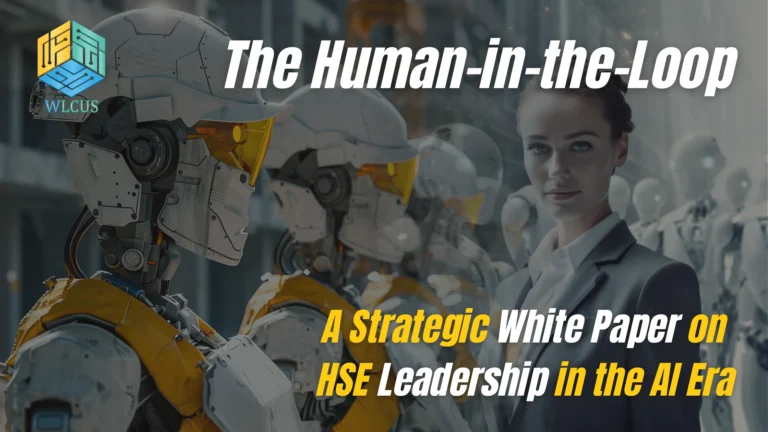
As we navigate the complexities of 2026, the industrial landscape is defined by a rapid pivot toward AI-enabled safety systems, advanced risk analytics, and predictive governance. While the technological capabilities available to modern enterprises are unprecedented, the most critical lesson of the current era is that technology alone cannot secure a high-risk environment. This paper argues that “Human-in-the-Loop” (HITL) leadership is not merely a preference but a functional necessity to bridge the gap between fragmented data and actionable wisdom.
Section 1: The 2026 Digital Landscape & The Tipping Point
The year 2026 represents a “Tipping Point” where digital transformation has moved from a strategic goal to a mandatory operational reality for high-risk sectors. Organizations are now integrating advanced systems that provide a level of visibility previously thought impossible.
1.1 Agentic AI & Control Tower Simulations
Modern HSE frameworks now utilize Agentic AI-systems capable of not just flagging risks, but autonomously initiating safety protocols based on real-time data. At the Global HSE Nexus 2.0, leaders will engage with AI HSE Assistant Test Drives and control tower simulations to understand how these agents operate in live environments.
1.2 Digital Twins and Predictive Decision-Making
Digital Twins have become essential for construction, infrastructure, and oil & gas operations. These real-time replicas allow leaders to run “what-if” scenarios, improving decision-making through predictive analytics and digital dashboards. By simulating complex work lifecycles, companies can identify “hotspots” before incidents occur.
Section 2: The Logic of "Human-in-the-Loop" (HITL)
Despite the rise of AI, the “Human-in-the-Loop” mandate remains the cornerstone of effective safety management. This requirement ensures that a human leader provides the final ethical and contextual “green light” before critical actions are taken.
2.1 Contextual Intelligence vs. Data Fragmentation
AI excels at identifying patterns within massive datasets, but it lacks the wisdom to interpret the “why” behind a data point. A machine can detect a micro-delay in a process, but only a human leader can recognize if that delay is caused by a worker’s fatigue, a personal crisis, or a perceived cultural barrier to speaking up. HITL leadership balances innovation with these vital human factors.
2.2 Ethical Oversight and Accountability
Algorithms are inherently trained on historical data, which may contain biases. Without human oversight, these biases can lead to flawed safety decisions. Human-centric leadership provides the necessary ethical “checkmate”, ensuring that safety protocols align with organizational values and human dignity rather than just statistical probability.
Section 3: Beyond Code - The Neurodiversity & Mental Health Factor
A truly future-ready HSE framework must prioritize the psychological and cognitive aspects of the workforce.
3.1 Neurodiversity as a Safety Asset
One of the trending themes for 2026 is the role of neurodiversity in safety leadership. Algorithms are designed for standardization, however, neurodivergent thinkers often possess a unique ability to spot non-linear risks that standard models might miss. Empowering these diverse cognitive styles creates a more resilient safety culture where “groupthink” is consistently challenged.
3.2 The VR Empathy Loop
Technology is now being used to amplify human empathy through immersive VR Mental Health Experience Zones. By using Virtual Reality to simulate the stress and mental load of high-risk tasks, leaders can gain a firsthand understanding of the frontline experience. This leads to better-designed support systems and more effective behavioral safety interventions.
Section 4: Strategic Frameworks & Industrial Applications
The shift toward HITL leadership is being championed by global authorities and industry leaders.
4.1 Research-Driven Safety Leadership
Organizations like the Krause Bell Group leverage decades of research, including Serious Injury and Fatality (SIF) studies, to develop customized interventions. Their “Safety Loop” integrates leadership decisions, culture, and risk exposure to drive measurable improvements. This approach emphasizes that leaders must influence safety beyond mere rules and compliance.
4.2 Critical Risk Management (CRM+)
Organizations who are at the center stage and global leaders in fatality prevention, utilizes AI-driven technology to achieve “Mission Zero”. These CRM+ platforms use predictive analytics and real-time data to identify critical control failures, but it specifically empowers leaders to verify these controls in the field. This ensures that the technology serves the human verifier, not the other way around.
Section 5: Preparing for the Future of Safety by 2030
The transition toward 2030 requires a dual-track strategy that addresses both technological innovation and human leadership.
Track 1: Technology & Innovation: Includes the adoption of AI HSE Assistants, blockchain for contractor safety, and gamified training toolkits.
Track 2: Human Leadership & Culture: Focuses on neurodiversity, mental health, and the development of leadership tools to strengthen culture and manage climate-related risks.
By balancing these tracks, organizations can design future-ready HSE frameworks that are both innovative and deeply human-centric.
The strategies outlined in this paper represent the new standard for the global HSE elite. To move from data-paralysis to human-centric mastery, professionals must engage with these concepts in a high-stakes, collaborative environment.
The Global HSE Nexus 2.0 in Berlin serves as the strategic “War-Room” for this transformation.
Experience the Innovation: Participate in AI HSE Assistant Labs, Predictive Analytics Demos, and VR Experience Zones.
Engage with Global Experts: Learn from 30+ international experts through strategic panels and the Mega-Panel on “The Future of Safety by 2030”.
Build Your Black Box Digital Toolbox: Walk away with actionable strategies and practical tools designed to elevate your leadership.
The machine is ready to analyze the data. The question is: Are you ready to provide the wisdom?
In May 2026, the world’s most forward-thinking HSE architects will gather at the Grand Hyatt Berlin to bridge the “Wisdom Gap.” This is your opportunity to step into a leadership role that balances cutting-edge AI with the irreplaceable human factor.
Will you be the leader who secures the future, or will you be left trying to explain a failure that the data predicted but your culture couldn’t prevent?
→ ACCESS THE NEXUS: REGISTER FOR THE GLOBAL HSE GATHERING IN BERLIN 2026 ←
Venue: Grand Hyatt Berlin
Dates: May 6th – 7th, 2026
Partners: Official recognition by IIRSM & NEBOSH,
Diamond Partner: Krause Bell Group.