
ISO 45001:2027 vs ISO 14001:2026: What Has Changed, What Is Still a Draft, and What HSE Teams Must Do Now
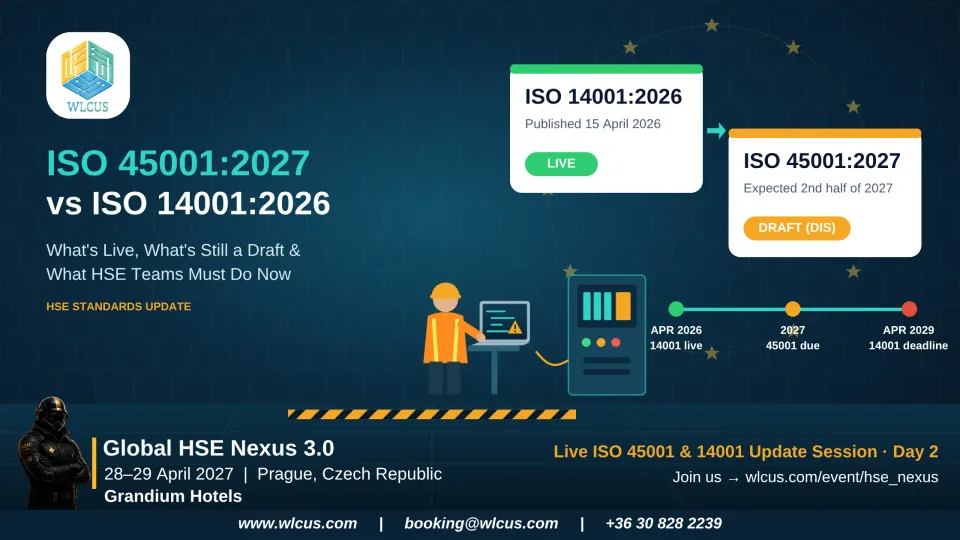
Last updated: 24 November 2026 — ISO 45001 at Draft International Standard (DIS) stage
If you manage health, safety or environment in 2026, you have probably heard three things at once: “ISO 14001 has changed”, “ISO 45001 is changing” and “you have three years”. Many HSE professionals are now asking the same question: is there an ISO 45001:2026, does my certificate still count, and should I start now or wait?
This guide gives you a clear answer. It separates what is already published from what is still a draft, explains the ISO 45001 2027 changes clause by clause, and gives you a practical plan for running both transitions together.
Quick answer
- ISO 14001:2026 is published. It was released on 15 April 2026 and replaces ISO 14001:2015 (ANSI/ANAB).
- ISO 45001:2027 is not published yet. The draft (DIS) was released in mid-June 2026; publication is expected in the second half of 2027 (DNV).
- There is no “ISO 45001:2026”. Your ISO 45001:2018 certificate remains the valid standard today.
- ISO 14001:2015 certificates stay valid until April 2029 at the latest (TÜV SÜD).
- Start now anyway. The direction of ISO 45001:2027 is already clear, and some changes need months to put in place.
The 2026–2029 timeline at a glance
| When | What happens | What it means for you |
|---|---|---|
| 2024 | Climate change amendment added to ISO 45001 and ISO 14001 | Already in force: consider climate in your “context” analysis |
| 15 April 2026 | ISO 14001:2026 published | Transition clock starts for environmental systems |
| Mid-June 2026 | ISO 45001 DIS released for 12-week ballot | Direction of the new OH&S standard is now visible |
| Second half of 2027 (expected) | ISO 45001:2027 published | Transition clock starts for OH&S systems |
| April 2029 | ISO 14001:2015 certificates expire | All EMS certificates must be on the 2026 edition |
| ~2030 (expected) | End of ISO 45001 transition (likely three years) | All OH&S certificates on the 2027 edition |
The ISO 45001 transition rules have not been formally set yet. Most certification bodies expect three years, in line with ISO 14001 (DQS).
5 myths HSE managers believe about the ISO changes
Myth 1: “There is a new ISO 45001:2026.”
There is not. ISO 14001 got a 2026 edition; ISO 45001 is still a draft. Anyone selling you “ISO 45001:2026 certification” today is selling something that does not exist.
Myth 2: “My certificate expires the day the new standard comes out.”
No. Certificates to the old edition remain valid during the transition period, but every certificate must move to the new edition before that period ends (ANSI/ANAB).
Myth 3: “It’s only a draft, so I can ignore it until 2027.”
Risky. At the DIS stage the structure and intent of a standard are largely settled (LRQA). New topics such as well-being, return to work and psychosocial hazards take months to build, not weeks before an audit.
Myth 4: “The changes are cosmetic, like ISO 14001.”
Not quite. Certification bodies describe the ISO 45001 changes as moderate, but more extensive than the recent ISO 9001 and ISO 14001 revisions (SGS).
Myth 5: “The 2024 climate amendment was a one-off note I can forget.”
It is now part of the core text. ISO 14001:2026 replaces the 2015 edition including the 2024 climate amendment (DNV), and the ISO 45001 draft integrates the same climate notes into clause 4.1.
ISO 45001 2027 changes: clause by clause (DIS stage)
The biggest shift in the ISO 45001 revision is a move from preventing harm to actively promoting work-related well-being. The draft keeps the familiar Plan-Do-Check-Act framework, but asks for more evidence and wider thinking. The table below is based on the DIS summary published by DNV; details may still change at the final draft (FDIS) stage.
| Clause (DIS) | What changes | What HSE teams should do |
|---|---|---|
| Whole standard | Text aligned to ISO’s Harmonized Structure; several clauses reorganised | Re-map your clause references and manual |
| 1, 5.1, 5.2, 6.1.2.3, 8.1.1 | New focus on promoting work-related well-being, not only preventing harm | Add well-being objectives and leadership commitment |
| 4.1 | 2024 climate change notes integrated | Show how heat, floods and extreme weather affect worker risk |
| 4.2, 7.4, 8.1.2, 8.2 | Explicit attention to the diversity of workers | Review risk assessments for gender, age, disability and neurodiversity |
| 6.1.2.1 | Hazard identification widened: new technologies, platform work, remote workers, psychosocial hazards, climate impacts | Update your hazard register and HIRA method |
| 6.1.2.2 | Documented results of risk assessments now explicitly required | Keep records of results, not only the method |
| 6.3 (new) | Planning of changes | Usually covered by your management of change |
| 8.1.3 (new) | Occupational health processes | Formalise health surveillance and exposure monitoring |
| 8.1.4 (new) | Return to work after injury and ill health | Write a controlled return-to-work process |
| 8.1.6 | “Externally provided processes, products and services” replaces procurement | Strengthen contractor and supplier controls |
| 10.1 | Continual improvement clauses merged | Minor wording update |
| Clause 3 | New definitions: work-related well-being, disability, external provider | Update your glossary and training |
Where most systems will fall short: psychosocial risk, return to work and worker diversity. These are cultural changes, not paperwork. If you are starting from zero, read our guides on the industrial case for psychological safety, inclusive safety mandates and protecting neurodiversity through human-centric leadership. For climate-driven heat risk, see Beyond the Heat Index: WBGT-based work-rest controls.
ISO 14001:2026 changes and transition: what is already live
ISO 14001:2026 is a moderate update, not a redesign. A key goal of the revision was to clarify existing requirements while limiting new ones (DNV). Plan-Do-Check-Act stays; what changes is how clearly auditors expect you to show results.
The main changes HSE and environmental teams should know:
- Harmonized Structure. Same structure and terms as ISO 9001 and the coming ISO 45001, which makes integrated systems easier.
- Climate change built in. The 2024 climate amendment is now part of the standard text.
- Stronger topics: climate change, biodiversity, life cycle thinking and change management are emphasised (DQS).
- Planned changes. Organisational changes that affect the EMS must be planned and controlled.
- Expanded Annex A. More guidance and examples to support consistent interpretation.
Transition rules: the transition period is three years from publication. ISO 14001:2015 certificates remain valid until April 2029 at the latest, depending on your certification body (TÜV SÜD). Most organisations will transition at a surveillance or recertification audit after a gap analysis. For the official overview, see ISO’s own summary of what has changed.
Running both transitions together: a 2026–2029 roadmap
If you hold both certificates, treat this as one programme, not two projects. Both standards now share the same Harmonized Structure, so one gap analysis and one document update can cover both.
- Now to Q1 2027: understand and assess. Train your core team on ISO 14001:2026 and the ISO 45001 DIS. Run one combined gap analysis against both.
- Q1–Q2 2027: fix the shared foundations. Update context (4.1) with climate risks, needs of interested parties (4.2), change planning (6.3) and leadership commitments once for both systems.
- 2027: transition ISO 14001. Move your EMS to the 2026 edition at your next surveillance or recertification audit.
- 2027 in parallel: build the new OH&S topics. Start the long-lead items now: psychosocial risk assessment, well-being objectives, a return-to-work process and stronger contractor controls.
- After ISO 45001:2027 is published: close the gap. Compare the final text with your draft-based work, adjust, and book a transition audit.
- By April 2029: both done. ISO 14001 must be finished by then; aim to finish ISO 45001 in the same audit cycle to save cost.
Tip: ask your certification body now whether they will combine both transition audits. Combining them can save audit days and cost.
Free download: ISO 45001:2027 Gap Analysis Checklist — a clause-by-clause checklist covering every change above. Request your copy.
Frequently asked questions
When will ISO 45001:2027 be published?
Publication is expected in the second half of 2027. The draft (DIS) was released in mid-June 2026 for a 12-week ballot.
Is there an ISO 45001:2026?
No. ISO 45001:2018 is the current standard until ISO 45001:2027 is published.
How long is the ISO 45001 transition period?
Not yet confirmed. Three years is widely expected, in line with ISO 14001:2026.
Is my ISO 14001:2015 certificate still valid?
Yes, until April 2029 at the latest. After that, only ISO 14001:2026 certificates are valid.
What are the biggest ISO 45001 changes?
Work-related well-being, psychosocial hazards, worker diversity, a new return-to-work requirement, occupational health processes, climate impacts and stronger control of external providers.
Should I wait for the final ISO 45001 text?
No. Start with the long-lead topics now and adjust when the final standard is published.
Can I combine ISO 14001 and ISO 45001 transition audits?
Usually yes. Both use the Harmonized Structure, so ask your certification body about a combined audit.
Get the ISO update live: Global HSE Nexus 3.0, Prague
Reading about ISO 45001:2027 is a start. Hearing what auditors will actually look for is better.
Global HSE Nexus 3.0 brings 300+ senior HSE leaders together on 28–29 April 2027 at the Grandium Hotel Prague. Day 2, “Building Resilient, Future-Ready Operations”, includes a dedicated ISO 14001 / ISO 9001 / ISO 45001 update session, so you can bring your gap-analysis questions straight to the experts.
The agenda also covers the themes this revision puts in the spotlight:
- Psychosocial risk and EU HSE law, including AI governance
- A psychological-safety case study from Škoda
- Contractor and fatigue risk, the core of the new “external provider” clause
- SIF prevention and critical-risk decisions for leaders
- Predictive analytics and AI in safety from Siemens Healthineers
- A live Crisis Room simulation and a Gen Z workforce forum
It takes place just as ISO 45001:2027 approaches publication, so it is the ideal moment to plan your transition with peers who are facing the same audit.
Join us in Prague at :Global HSE Nexus 3.0
For more on where HSE leadership is heading, read The Future of HSE Leadership in 2027 and our earlier guide to health and safety standards and technology.
Disclaimer: this article reflects publicly available information on the ISO 45001 DIS and ISO 14001:2026 as of 24 November 2026. Always check final requirements with your certification body.