

The European pharmaceutical commercialization landscape has officially fundamentally shifted. We are no longer preparing for the New European Health Technology Assessment (HTA) Era we are actively living in it.
As mandatory Joint Clinical Assessments (JCA) kick into gear for all oncology treatments and Advanced Therapy Medicinal Products (ATMPs), biopharma companies face an intense, unyielding reality: a strict 100-day submission window.
For Market Access Directors, HEOR leads, and specialized consultants, this regulatory shift has triggered a highly specific industry phenomenon: “PICO anxiety.” With member states diverging on how they define populations, interventions, comparators, and outcomes, local data fragmentation is threatening pipeline sustainability across the EU.
To survive, cross-functional teams must move past theoretical compliance and master the architecture of regulatory-grade Real-World Evidence (RWE).
What is Driving 'PICO Anxiety' in 2026?
The core challenge of the JCA process boils down to the formulation of the PICO framework:
● Population (Which patient subgroups are being evaluated?)
● Invention (The medicine under review)
● Comparator (What existing therapy is it being measured against?)
● Outcome (The clinical and real-world endpoints)
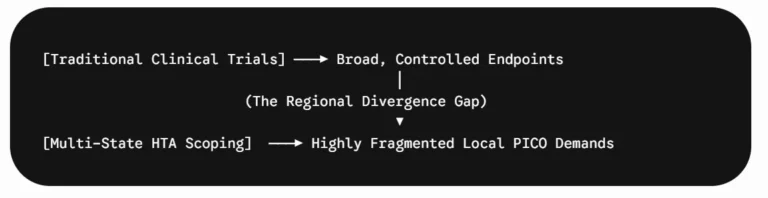
Because individual EU member states maintain distinct standard-of-care baselines, a comparator drug accepted in Germany might be completely dismissed by an HTA body in France or Spain. Biopharma companies are forced to anticipate dozens of localized PICO scoping variations simultaneously.
If your statistical models fail to align with a specific country’s local payer priorities, your drug faces devastating delays in pricing and reimbursement negotiations, effectively locking patients out of life-saving therapies.
The Strategic Solution: Leveraging DARWIN EU 2.0 and AI Evidence Synthesis
To proactively mitigate selection bias and bridge the gap between static clinical trials and diverse multi-state requirements, pharma solution providers are leaning heavily on standardized data networks.
The European Medicines Agency’s (EMA) DARWIN EU network has evolved. Generating regulatory-grade evidence now requires absolute data interoperability. Leading consulting firms and data service providers are deploying machine learning and AI-driven evidence synthesis to automate complex data extraction from electronic health records (EHRs) across borders.
By shifting from broad, generalized data pools to precision, country-specific real-world data (RWD), forward-thinking manufacturers can eliminate statistical surprises well before the 100-day submission countdown begins.
Building Your Strategy: The Actionable Blueprint
Navigating national HTA readiness requires breaking down the traditional silos between clinical development, regulatory affairs, and commercial strategy.
Run predictive analytics to simulate how different EU member states will formulate their PICO demands based on historical local reimbursement behaviors.
Structure your RWE strategy around DARWIN EU standards to ensure data packages carry the necessary scientific integrity required by cross-border HTA reviewers.
Utilize commercial AI tools to compress the “data-to-submission” lifecycle, giving your rapid-response teams a cushion during the frantic 100-day JCA phase.
Entering the Implementation War Room: Amsterdam 2026
You cannot solve systemic industry fragmentation from behind a desk. Survival requires direct collaboration with the architects of the European HTA landscape.
On October 21-22, 2026, the industry’s definitive briefing, the European RWE & Market Access Summit 2026, is convening in Amsterdam, Netherlands.
Organized by WLCUS, this edition serves as a practical implementation war room designed specifically to dismantle “PICO anxiety”. Cross-functional teams will gain access to direct case studies from market access trailblazers, including tactical presentations on global HTA policy from senior leaders at AstraZeneca.
Key Summit Tracks You Can't Afford to Miss:
● JCA Submission Mastery: Practical roadmaps for oncology and ATMP dossiers under aggressive timelines.
● Bias Mitigation & Statistical Alignment: Overcoming regional divergence in comparator definitions.
● DARWIN EU 2.0 Operations: Direct technical briefings on multi-state data interoperability.
● Payer & Regulator Closed-Door Networking: Engaging directly with HTA assessors and policy makers to accurately gauge local payer sentiment
Market Access & JCA FAQ
What is the timeline for mandatory JCA oncology dossiers?
Under the current European HTA regulation, biopharma manufacturers have a strict 100-day submission window to deliver comprehensive clinical data packages once the JCA process is formally initiated.
How does RWE mitigate selection bias in HTA submissions?
Real-World Evidence (RWE) fills the evidence gaps left by randomized controlled trials (RCTs) by providing localized, population-level health data. By utilizing rigorous statistical matching and predictive frameworks, manufacturers can align their clinical endpoints with country-specific comparators.
What is the primary role of AI in HEOR evidence synthesis?
AI and machine learning streamline HEOR (Health Economics and Outcomes Research) workflows by accelerating data mining across fragmented health registries. This radically compresses the time it takes to synthesize raw real-world data into submission-ready evidence.
Ensure Long-Term Market Sustainability For Your Pipeline. Don’t let regional regulatory divergence delay your commercial rollout. Review registration tiers, secure your pass, and join global pharma leaders this October in Amsterdam.
Request the Agenda here : European RWE & Market Access Summit 2026 Join us in Amsterdam