
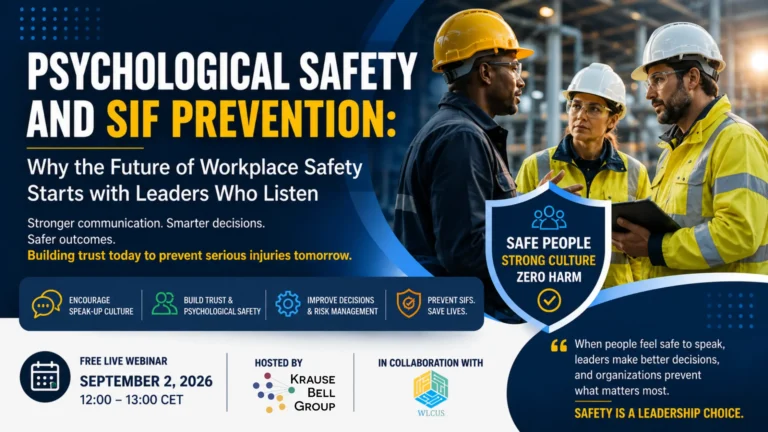
By WLCUS in Collaboration with Krause Bell Group
Introduction
Every year, organizations invest millions in safety management systems, risk assessments, training programs, and compliance initiatives. Yet despite these efforts, serious workplace injuries and fatalities continue to occur across industries including manufacturing, construction, energy, pharmaceuticals, logistics, mining, chemicals, and transportation.
This raises an important question:
If organizations have more safety procedures than ever before, why do serious incidents still happen?
The answer often lies beyond compliance.
Many catastrophic events are not caused by a lack of rules. Instead, they occur because early warning signs were overlooked, concerns were never communicated, or employees did not feel comfortable speaking up.
This is where Psychological Safety becomes one of the most important foundations of modern safety leadership.
Recognizing this growing challenge, Krause Bell Group, in collaboration with WLCUS, is hosting a free live webinar titled “Psychological Safety and SIF Prevention – What Every Leader Needs to Know.” The webinar explores how leadership, communication, and organizational culture directly influence the prevention of Serious Injuries and Fatalities (SIF).
What Is Psychological Safety?
Psychological Safety is the shared belief that individuals can express ideas, ask questions, admit mistakes, or raise concerns without fear of embarrassment, punishment, or retaliation.
In a psychologically safe workplace, employees feel comfortable saying:
- “I think something isn’t right.”
- “I believe this process is unsafe.”
- “I made a mistake.”
- “Can we stop this task?”
- “I have a better idea.”
These conversations often prevent incidents long before they occur.
When employees stay silent because they fear criticism or negative consequences, organizations lose one of their most valuable safety controls, the frontline perspective.
As highlighted in the webinar agenda, psychological safety strengthens open communication, supports effective risk management, and improves decision-making in high-consequence environments.
Understanding Serious Injury and Fatality (SIF) Prevention
Serious Injury and Fatality (SIF) Prevention focuses on identifying and managing risks that have the potential to cause life-changing or fatal outcomes.
Unlike traditional safety programs that often measure total recordable incidents or lost-time injuries, SIF Prevention concentrates on high-consequence events.
Examples include:
- Falls from height
- Confined space incidents
- Energy isolation failures
- Vehicle collisions
- Process safety failures
- Heavy equipment incidents
- Electrical hazards
- Chemical releases
Many organizations report excellent safety statistics while still remaining vulnerable to a catastrophic event.
This demonstrates that low injury rates do not always equal low catastrophic risk.
The goal of SIF Prevention is to identify weak signals before they become tragic outcomes.
Why Compliance Alone Is No Longer Enough
For decades, organizations have focused heavily on:
- Policies
- Procedures
- Audits
- Inspections
- Personal Protective Equipment (PPE)
- Regulatory compliance
These remain essential.
However, experience has shown that systems alone cannot eliminate serious incidents.
The missing element is often human behavior.
Employees may notice:
- Equipment operating abnormally
- Unsafe shortcuts
- Fatigue
- Process deviations
- Leadership decisions increasing operational risk
Yet if people do not feel safe reporting these observations, valuable information is lost.
Psychological Safety creates the environment where these conversations happen before an incident occurs.
The Safety Loop: Connecting Leadership to Safety Outcomes
One of the central concepts explored during the webinar is The Safety Loop.
According to the webinar overview, leadership decisions and practices shape systems, workplace context, and organizational culture. These, in turn, influence exposure to risk and overall safety outcomes. When those connections remain strong, organizations create continuous learning and improvement. When they weaken, safety performance can stagnate despite ongoing leadership efforts.
This model reminds leaders that every decision influences:
- Employee trust
- Communication quality
- Operational discipline
- Risk visibility
- Organizational learning
Safety is therefore not merely the result of procedures; it is also shaped by the everyday decisions leaders make.
Upward Communication: One of the Most Powerful Safety Controls
One of the webinar’s key themes is the relationship between Psychological Safety and Upward Communication.
Upward communication occurs when frontline employees confidently communicate concerns to supervisors and leadership.
Examples include:
- Reporting unsafe conditions
- Challenging unsafe decisions
- Sharing lessons learned
- Reporting near misses
- Suggesting improvements
Organizations that encourage upward communication typically identify hazards much earlier than organizations where employees remain silent.
The strongest safety cultures are built on dialogue, not fear.
Building a High-Trust Safety Culture
Strong safety cultures share common characteristics.
Employees:
- Report hazards early.
- Ask questions without hesitation.
- Share lessons from mistakes.
- Stop unsafe work when necessary.
- Participate in continuous improvement.
- Trust leadership decisions.
Leaders:
- Listen actively.
- Encourage feedback.
- Recognize safe behaviors.
- Learn from incidents instead of assigning blame.
- Continuously improve systems.
Trust becomes the foundation of operational excellence.
Practical Benefits of Psychological Safety
Organizations that strengthen Psychological Safety often experience:
Better Hazard Identification
Employees identify risks before incidents occur.
Faster Learning
Mistakes become opportunities for improvement.
Improved Decision-Making
Leaders receive better operational information.
Higher Employee Engagement
Employees become active participants in safety.
Stronger Risk Management
Small issues are addressed before becoming major events.
What Participants Will Learn
According to the webinar agenda, attendees will gain practical knowledge on:
- Defining Psychological Safety and its role in workplace safety.
- Understanding which elements of Psychological Safety influence SIF outcomes.
- Applying practical approaches to strengthen SIF Prevention.
- Learning from real-world examples demonstrating Psychological Safety in action.
The session is designed for leaders seeking practical, leadership-focused approaches to improving safety performance.
Meet the Trainer
The webinar features two experienced safety leaders from Krause Bell Group:
Filip Coumans
Co-CEO & Managing Director (EMEA)
Thomas Meier
Vice President & Director (Middle East)
Together, they bring decades of experience helping organizations strengthen leadership, improve decision-making, and build sustainable safety cultures.
Krause Bell Group specializes in developing customized interventions that help organizations build safer and more successful workplaces.
Its consulting approach focuses on:
- Leadership development
- Safety culture transformation
- Decision-making improvement
- Organizational learning
- Sustainable performance improvement
According to the webinar brochure, the organization’s work is grounded in research, including the landmark 2010 Serious Injury and Fatality (SIF) study led by Tom Krause, its proprietary Safe Decision Making® findings and model, and the 7 Insights Into Safety Leadership framework.
Safety leaders today face increasingly complex challenges.
Organizations must not only comply with regulations but also create workplaces where people feel confident to speak up, question assumptions, and contribute to safer decisions.
Psychological Safety is emerging as one of the most valuable leadership capabilities because it strengthens communication, improves learning, and supports proactive risk management.
For organizations seeking to reduce the likelihood of serious injuries and fatalities, creating an environment of trust may be just as important as implementing the right safety procedures.
Whether you are an HSE Director, Safety Manager, Operations Leader, Plant Manager, Risk Professional, or Executive responsible for protecting people, this webinar offers practical insights into building stronger safety cultures through leadership and communication.
Webinar Details
Psychological Safety and SIF Prevention: What Every Leader Needs to Know
📅 Date: 2 September 2026
🕛 Time: 12:00–13:00 CET
🎙️ Hosted by: Krause Bell Group in collaboration with WLCUS
🔗 Register Now: Online Registration here…
Join safety professionals from around the world to explore how psychological safety, leadership, and effective communication can help prevent serious injuries and create workplaces where every employee has the confidence to speak up.