
When Routine Maintenance Becomes a Critical Risk:
What Leaders Miss Before Work Starts
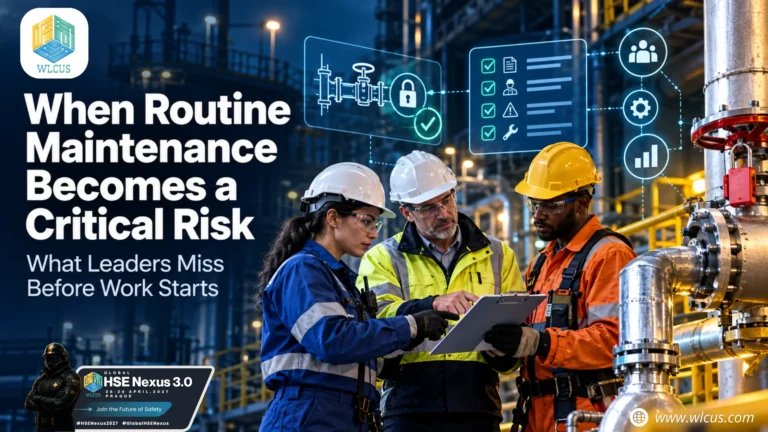
A leaking gasket can look like a straightforward repair. The risk changes when a team has to open pipework, rely on an isolation and work from a position the original plan did not account for.
A recent UK Health and Safety Executive (HSE) case shows how quickly those conditions can come together. An employee and a contractor were replacing a gasket on steam pipework at a food manufacturing site when hot water escaped and scalded them. HSE found that the task had not been adequately risk assessed, suitable isolation and lock-off procedures had not been used, and the work at height lacked sufficient controls. It also identified inadequate supervision and monitoring. The company was fined £594,000.
For HSE and operations leaders, the lesson goes beyond a single maintenance procedure. What must an organisation verify before it allows a routine job to become intrusive work?
“Routine” describes the job’s frequency, not its risk
Maintenance teams may have replaced hundreds of gaskets. Familiarity can make the next job appear predictable, even when the equipment, access point or operating condition differs.
In the HSE case, the workers could not reach the relevant section of pipework from the gantry and stepped onto the boiler to carry out the task. They were then exposed to hot water when they removed the gasket. These details matter because the work as performed differed from a simple description of “replace a leaking gasket”.
A useful pre-work question is therefore:
Does the plan describe the job people will actually have to do at the point of work?
If the answer changes once the team arrives, the controls need to be reconsidered before the work continues.
Verify the isolation before opening the system
An instruction to isolate equipment is only the beginning. The team needs to know what is being isolated, which sources of energy or hazardous material remain, who controls the isolation and how its effectiveness will be proved.
HSE says planning for intrusive work should coordinate documents such as risk assessments, method statements, permits and isolation certificates. The integrity of an isolation should be proved before work proceeds. Its guidance on safe isolation addresses the risk of releasing hazardous substances during activities such as maintenance.
For leaders, the critical assurance question is not simply whether a permit or certificate exists. It is whether the people doing the work can demonstrate that the system is in the condition the plan assumes.
Look at the risks that meet at the worksite
The steam-pipe task involved more than exposure to hot water. The workers also moved off the gantry and worked at height. HSE identified shortcomings in controls for that risk as well as in isolation, task assessment and supervision.
This is where a narrow task description can fail. A maintenance plan may concentrate on the pipework while overlooking access, positioning, changes to the job and the interaction between employees and contractors.
Before authorising work, supervisors and work teams should be able to explain:
- What could be released when the system is opened?
- How has the isolation been proved effective?
- Can the task be reached and completed from a safe working position?
- Who will stop and reassess the job if conditions differ from the plan?
- Are the employee, contractor and supervisor working from the same understanding?
These questions are most useful when asked at the worksite, where the planned method can be compared with the physical task.
Contractor oversight is a shared operating challenge
When an employee and a contractor work together, responsibilities must be clear in practice. Both need to understand the equipment state, the safe method, the limits of the authorisation and the route for raising a concern.
The recent case should prompt organisations to examine how they coordinate contractor work: who confirms an isolation, who checks that access is suitable, who supervises the task and who has authority to pause it. HSE’s findings in this case included inadequate supervision and monitoring of whether expected procedures were followed.
The purpose is to make critical controls visible and testable at the moment they matter.
Learn from the moment the plan changes
A worker discovering that a gantry does not provide access is valuable safety information. It signals a gap between the intended method and the worksite.
Organisations can learn from such moments before anyone is injured. Maintenance teams should be able to raise a change without pressure to improvise around the original plan. Supervisors need a clear way to reassess the task, and leaders need to know whether those pauses happen in everyday work.
Useful measures may include how often intrusive maintenance is stopped for reassessment, what changes are found at the worksite, and whether isolation checks are recorded and verified. These measures can reveal more about control quality than simply counting completed permits.
Five questions for HSE and operations leaders
- Where could routine maintenance expose workers to stored energy, pressure or hazardous substances?
- How is the effectiveness of an isolation proved before intrusive work begins?
- What happens when the planned access or method does not match conditions at the worksite?
- Can employees and contractors explain who is supervising and who can stop the job?
- Are lessons from changed or paused jobs reaching the people who design future work?
The aim is to find where a control that looks complete on paper becomes uncertain in use.
Critical risk decisions happen before the first tool is used
The HSE case illustrates the cost of allowing assumptions about a familiar task to stand in for verification. The strongest intervention may occur before maintenance starts: checking the actual job, proving the isolation, resolving access problems and giving the team a clear reason to pause when conditions change.
Those are operational decisions as much as safety procedures. Leaders shape the time, resources and supervision available to make them well.
Continue the discussion at Global HSE Nexus 3.0, taking place in Prague on 28–29 April 2027. The summit will bring HSE and operations leaders together to examine critical-risk decisions, contractor resilience and how organisations learn from everyday work.