
The "Safety Air-Gap" is Dead:
Why Your 2026 Leadership is the New Firewall
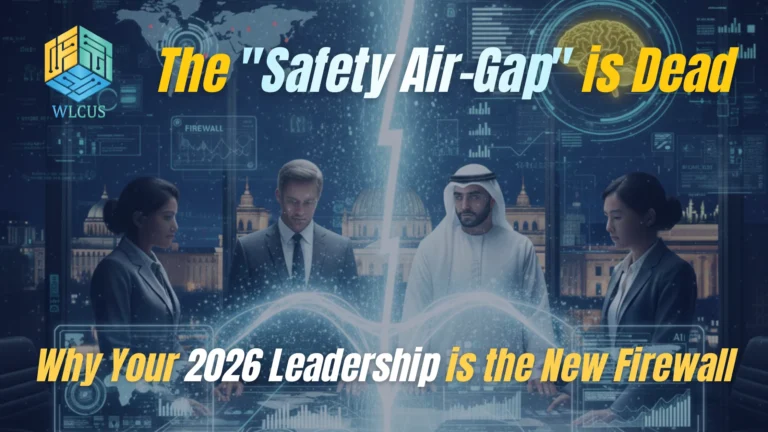
For decades, the industrial world relied on a comforting myth: the Air-Gap. We believed that as long as our Operational Technology (OT), the valves, turbines, and rail switches, was physically disconnected from the office internet (IT), our workers were safe.
In 2026, that myth is officially dead. Between remote diagnostics, AI-driven predictive maintenance, and cloud-based safety dashboards, the gap hasn’t just been bridged; it’s been obliterated. Connectivity is the engine of efficiency, but it has turned every digital “ping” into a potential physical hazard.
The Fragmented Reality: Data is Not Wisdom
The biggest hurdle to Safety 4.0 isn’t the technology; it’s the data fragmentation that leaves leaders feeling paralyzed. In 2026, a typical rail or energy network generates petabytes of data every hour. To a machine, this is just a series of 1s and 0s.
AI is brilliant at Data Fragmentation, it can scan 10,000 sensors for a 0.2% thermal spike that no human eye would ever catch. But AI lacks Wisdom. It can tell you what is happening, but it cannot tell you why it matters to your culture.
Consider the 2025 “Sector 4” Case Study: An AI system at a major logistics hub flagged that forklift drivers were hesitating at a specific corner 15% more often. The data suggested a “productivity dip.” However, a Wise Leader investigated and found that a new LED light was causing a glare on the floor that looked like an oil spill. The AI saw a delay; the Leader saw a looming psychological hazard. The leader’s wisdom prevented the accident that the AI only “counted.”
The Elephant in the Boardroom: The Fear of Replacement
Let’s address the silence: many HSE professionals are hesitant to fully adapt AI because they fear it will eventually replace them.
The truth? AI cannot have “Human-in-the-Loop” accountability. AI can forecast a risk, but it cannot take ethical responsibility for a shutdown.
AI can detect fatigue, but it cannot offer empathy to a grieving worker.
AI can model a crash, but it cannot lead a Safety Culture change.
Leadership in 2026 is about Augmentation, not Replacement. The most obsolete leader isn’t the one replaced by AI; it’s the one who refuses to use it. When you ignore AI data, you are essentially flying a plane with your eyes closed because you “prefer the feel of the wind.”
The "New Firewall" Strategy
Since the Air-Gap is dead, your Human Leadership must become the new protective layer. This requires three shifts:
Integrated Governance: Stop holding “Cyber” meetings and “Safety” meetings separately. In 2026, a cyber-breach is a life-safety event.
From Reactive to Prescriptive: Use AI to give you the “Where” and the “When,” but reserve the “How” for your experienced human intuition.
Psychological Safety: Foster an environment where workers aren’t afraid of the AI sensors, but see them as “digital guardian angels” that empower their own expertise.
The “Safety Air-Gap” may be dead, but your career doesn’t have to be. The difference between a leader who is managed by technology and a leader who masters it is Perspective.
At the Global HSE Nexus 2.0 in Berlin (May 6-7), we aren’t gathering to watch PowerPoint presentations. We are gathering to enter the Rail, Energy, and Infrastructure War-Rooms.
This is where the world’s elite HSE Architects come to solve the “Wisdom Gap.” You will network with peers from to see exactly how they are bridging data with human action before the next “100-year storm” hits.
Don’t wait for the next incident report to land on your desk. Be the leader who saw the data, applied the wisdom, and secured the future.
Secure Your Seat in Berlin: www.wlcus.com | 📧 Delegate & Partner Inquiries: booking@wlcus.com | Call: +36 30 828 2239