
When Safety Competes With Profit:
Who Really Makes the Final Decision?
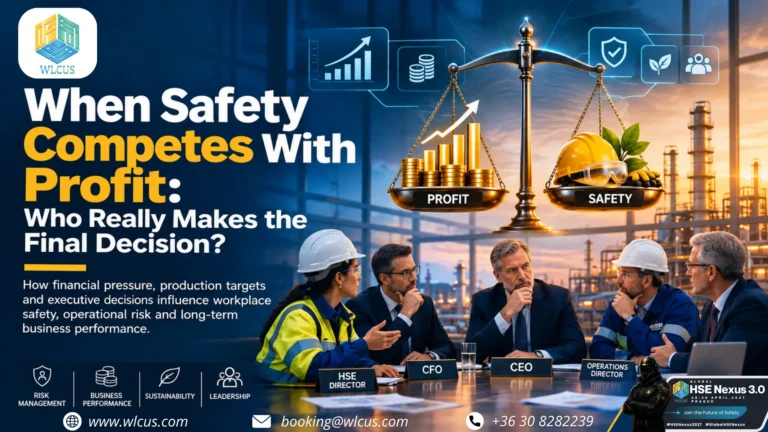
How financial pressure, production targets and executive decisions influence workplace safety, operational risk and long-term business performance.
Every organisation says that employee safety comes first.
It appears in corporate policies, annual reports, leadership presentations and workplace safety campaigns. Executives frequently describe protecting people as a fundamental business priority.
But what happens when that commitment is tested by financial pressure?
What happens when a safety investment threatens profitability, a production deadline cannot be extended, or the safest operational decision conflicts with quarterly financial targets?
Who has the final say the Chief Executive Officer, Chief Financial Officer, Operations Director or Head of Health, Safety and Environment (HSE)?
This question exposes one of the most difficult challenges in modern workplace safety leadership.
The real conflict is not necessarily between safety and profitability. It is between short-term commercial pressures and the organisation’s responsibility to manage risks that could cause serious harm.
Understanding that distinction is essential for building safer workplaces, stronger corporate governance and resilient business operations.
Why Workplace Safety Is a Business Decision, Not Just an HSE Responsibility
Workplace safety is often associated with training, risk assessments, inspections, protective equipment and regulatory compliance.
These activities are essential, but they represent only part of how organisations manage risk.
Many decisions affecting employee safety originate outside the HSE department.
Financial planning determines how resources are allocated. Operations management establishes production schedules. Procurement influences supplier selection. Executive leadership approves investments, restructuring and business expansion.
Each function can influence the conditions under which employees work.
Consider an organisation facing declining profit margins.
Management may consider reducing expenditure, accelerating production or postponing non-essential investments. Some changes may be commercially justified and introduce little additional risk.
Others may affect staffing capacity, equipment reliability, employee workload or the effectiveness of safety-critical systems.
The important question is whether the organisation evaluates the safety consequences before making the financial decision.
The UK Health and Safety Executive’s guidance on effective safety leadership explicitly identifies the integration of health and safety management with business decisions as a principle of strong leadership.
This reinforces an important point: occupational safety is not simply an operational compliance function. It is a corporate governance responsibility.
When Financial Pressure Changes the Organisation's Risk Exposure
Financial pressure does not automatically create an unsafe workplace.
Businesses must control costs, improve productivity and allocate resources responsibly.
However, financial decisions can increase workplace risk when their consequences are poorly understood or when critical safeguards are weakened.
Three situations deserve particular attention.
1. Production targets become more important than operational capacity
Imagine a manufacturing organisation facing unusually high customer demand.
Leadership increases production targets without reviewing whether staffing levels, equipment capacity and existing operating arrangements can safely support the additional workload.
Employees may face longer working hours, greater fatigue or increased pressure to maintain output.
The financial objective may be reasonable. The problem arises when the organisation assumes that existing risk controls remain effective despite changing operating conditions.
Higher productivity should not be confused with sustainable operational performance.
2. Cost reduction affects safety-critical resources
A business may seek to reduce expenditure through restructuring, outsourcing or tighter departmental budgets.
These measures can improve efficiency when properly designed.
But reducing access to competent supervision, technical expertise, emergency preparedness or essential safeguards may create risks that are not immediately visible in financial reports.
A cost-saving proposal should therefore be evaluated against both its expected financial benefits and its potential operational consequences.
3. Short-term financial targets overshadow long-term resilience
Some preventive investments deliver benefits that are difficult to measure over a single financial quarter.
A project designed to reduce exposure to a low-frequency but potentially catastrophic event may receive less attention than an initiative promising immediate productivity improvements.
Yet the absence of an incident does not establish that the underlying risk is insignificant.
A successful quarter does not necessarily mean an organisation has made successful risk decisions.
The Financial Cost of Poor Workplace Safety
Workplace incidents can produce consequences extending far beyond immediate injury-related expenses.
Depending on the severity and circumstances, an incident may involve:
Medical treatment, compensation and rehabilitation expenses.
Production interruptions and operational downtime.
Equipment damage and emergency response costs.
Regulatory investigations, enforcement action and legal expenses.
Supply-chain disruption and contractual consequences.
Reputational damage and declining employee confidence.
Increased insurance costs or reduced access to commercial opportunities.
These consequences vary considerably by industry, jurisdiction and incident type.
The European Agency for Safety and Health at Work recognises that poor occupational safety leadership can create significant financial costs, while effective leadership can support productivity, efficiency and employee morale.
However, the financial argument for safety requires careful interpretation.
Not every preventive measure produces a directly measurable return on investment. Some safeguards are necessary because they fulfil legal obligations or prevent unacceptable harm.
The value of prevention cannot always be expressed as a simple financial return.
Nevertheless, organisations should understand how risk reduction contributes to operational continuity, workforce protection and long-term business stability.
The CFO–HSE Leadership Gap: Why Safety Investments Struggle for Approval
One of the most important challenges facing senior HSE professionals is communicating the business relevance of prevention.
HSE teams typically assess hazards, control effectiveness, incident potential and regulatory requirements.
Finance teams evaluate investment priorities, available capital, financial exposure and organisational sustainability.
Both functions provide essential perspectives.
The challenge emerges when they evaluate the same proposal using different information.
For example, an HSE Director may request investment in an additional protective system because existing arrangements provide insufficient assurance against a severe incident.
A CFO may ask whether the proposed expenditure is necessary, whether alternative measures are available and how the investment compares with competing priorities.
These are legitimate questions, provided legal requirements and essential safety standards are not treated as optional financial trade-offs.
The solution is not for HSE professionals to abandon technical risk assessment in favour of financial language.
Instead, they should translate technical findings into information that supports informed executive decisions.
A stronger safety investment proposal should explain:
The hazard and credible consequences being addressed.
The existing controls and evidence of their effectiveness.
The uncertainty surrounding current risk exposure.
The available options for reducing risk.
The cost, operational impact and limitations of each option.
The consequences of delaying or rejecting necessary action.
This enables executives to evaluate prevention as part of responsible capital allocation.
The most effective HSE leaders do not simply request additional budgets. They help decision-makers understand what the organisation is protecting and why.
Who Is Accountable When Safety and Commercial Priorities Conflict?
A fundamental question in corporate risk governance is who has the authority to make decisions involving significant workplace hazards.
Responsibility can become unclear when multiple departments influence the same outcome.
The Operations Director may control production schedules.
Finance may approve expenditure.
HSE may provide specialist risk advice.
Executive management may establish commercial priorities.
But when these priorities conflict, the organisation needs an effective decision-making framework.
The UK Health and Safety Executive’s leadership guidance for directors and boards emphasises the role of senior leadership in managing organisational health and safety risks.
Accountability arrangements differ across jurisdictions and corporate structures. Nevertheless, effective governance generally requires clear responsibilities, competent advice, appropriate escalation and documented decisions.
Four questions can help leadership teams evaluate their arrangements:
Who is authorised to make the decision?
The organisation should establish decision-making authority proportionate to the seriousness of the risk.
What evidence supports the decision?
Relevant technical assessments, operational information and control-effectiveness evidence should inform the outcome.
When must a decision be escalated?
Significant uncertainties, unacceptable exposure or inadequate safeguards should trigger appropriate review.
Who verifies that the agreed controls remain effective?
Approval alone is insufficient. Organisations must also ensure that the measures on which decisions depend are implemented and maintained.
A strong governance framework allows departments to challenge assumptions without creating unnecessary conflict.
Shared responsibility should strengthen accountability not make it impossible to identify who owns the decision.
Why Safety Performance Indicators Alone Cannot Tell the Full Story
Many organisations monitor workplace safety using injury rates, lost-time incidents, audit findings and training completion.
These indicators can support performance assessment, but they do not provide a complete picture of risk exposure.
An organisation may experience relatively few recordable injuries while still operating with weaknesses in controls designed to prevent severe incidents.
Conversely, a rise in reported concerns may reflect better workforce engagement rather than deteriorating safety performance.
For executives, this means safety reporting should extend beyond incident counts.
Useful questions include:
Are significant operational risks understood at executive level?
Are critical safeguards functioning as intended?
Are major organisational changes creating new exposure?
Are employees able to raise concerns and receive meaningful responses?
Are risk-reduction investments progressing as planned?
Are important assumptions about operational capacity still valid?
The HSE leadership checklist provides practical questions for boards reviewing safety arrangements, management systems, workforce consultation and performance reporting.
The objective is not to eliminate traditional safety metrics.
It is to ensure they are interpreted alongside information about the risks that matter most.
Good safety reporting should help leaders make better decisions not simply reassure them that past performance was acceptable.
How to Integrate Safety Into Financial and Strategic Decision-Making
Organisations seeking to strengthen integrated risk leadership can begin with five practical changes.
1. Include HSE expertise in strategic investment decisions
Significant capital projects, restructuring programmes and operational changes should consider relevant occupational safety implications before commitments are finalised.
Early involvement allows risks to be addressed during planning rather than after commercial decisions become difficult to reverse.
2. Evaluate safety consequences alongside financial outcomes
Business cases should identify material operational risks, proposed safeguards and the consequences of alternative decisions.
This does not mean assigning an artificial monetary value to every possible injury.
It means recognising that risk exposure can materially affect business continuity and responsible resource allocation.
3. Establish clear executive accountability
Organisations should define which decisions require specialist advice, senior management approval or board-level oversight.
Responsibilities should be understood across Finance, Operations, HSE and other relevant functions.
4. Improve communication between technical and financial teams
HSE professionals need opportunities to explain technical risks in language that supports strategic decision-making.
Finance and executive leaders, in turn, need sufficient understanding of uncertainty, critical controls and legal obligations to evaluate proposals responsibly.
5. Review decisions after implementation
A decision that appeared reasonable during planning may produce unexpected operational consequences.
Leadership teams should periodically assess whether assumptions remain valid, controls remain effective and corrective action is required.
This reflects the continuous-improvement approach described in the HSE’s Plan, Do, Check, Act framework.
Integrating safety into business strategy is not about adding bureaucracy. It is about improving the quality of decisions that affect people and operations.
Can Workplace Safety and Profitability Work Together?
Safety and profitability are sometimes presented as competing objectives.
In practice, effective risk management can support operational reliability, workforce confidence and sustainable business performance.
Well-designed processes may reduce disruption. Competent workforce planning may improve consistency. Effective safeguards may help prevent incidents that would otherwise interrupt operations.
But organisations should avoid assuming that every safety improvement automatically increases profitability.
Some necessary measures require substantial expenditure without producing immediate commercial benefits.
Responsible leadership means understanding when safety and financial objectives reinforce each other—and when financial preferences must give way to legal obligations or essential risk controls.
The most resilient organisations are not those that avoid difficult trade-offs.
They are those that make decisions transparently, evaluate credible consequences and maintain appropriate safeguards even under commercial pressure.
Frequently Asked Questions
Is workplace safety more important than profitability?
Workplace safety and profitability are not inherently opposing objectives. Businesses must remain financially viable while meeting legal obligations and protecting workers. Where commercial goals conflict with necessary safety safeguards, organisations must not disregard those safeguards merely to improve financial results.
Who is ultimately responsible for health and safety in a company?
Legal responsibilities depend on the jurisdiction and organisational structure. Employers and senior leadership have important duties, while managers, supervisors, employees and specialist HSE professionals also have defined responsibilities. Organisations should establish clear accountability rather than treating safety as the responsibility of one department.
How does financial pressure affect workplace safety?
Financial pressure can influence staffing, workloads, investment decisions and operational priorities. Risks may increase when organisations reduce essential resources, weaken safeguards or introduce changes without properly evaluating their safety consequences.
How can HSE leaders justify safety investments to executives?
Effective proposals explain the relevant hazards, potential consequences, existing controls, available alternatives, uncertainty and operational implications. Financial information can support the business case, but legal duties and essential worker protections must remain central.
What is integrated risk leadership?
Integrated risk leadership is an approach in which safety, operational, financial and strategic risks are considered together during business decision-making. It encourages collaboration between HSE, Finance, Operations and executive management while preserving clear accountability.
Can a company have good safety statistics but still face serious risks?
Yes. Low recorded injury rates do not necessarily demonstrate that all serious hazards are effectively controlled. Organisations should assess critical safeguards, operational changes, risk exposure and other relevant indicators alongside historical incident data.
Conclusion: The Most Important Safety Decisions May Be Financial Decisions
When safety competes with profit, the most important question is not which department has the strongest argument.
It is whether the organisation has the leadership, evidence and governance needed to make a responsible decision.
A financially attractive proposal can still introduce unacceptable risk.
A necessary safety investment may not generate immediate measurable returns.
And strong historical safety performance cannot guarantee that future operational decisions will be safe.
For CEOs, CFOs, COOs and HSE Directors, the challenge is to ensure that business performance is pursued without losing sight of the people and systems that make it possible.
Because the true test of safety leadership is not what an organisation promises when business is going well. It is what leadership decides when protecting people becomes commercially difficult.
The question every executive team should ask is simple:
Are our financial decisions strengthening operational resilience or quietly increasing the risks our workforce must carry?
Continue the discussion at Global HSE Nexus 3.0, taking place in Prague on 28–29 April 2027. The summit will bring HSE and operations leaders together to examine critical-risk decisions, contractor resilience and how organisations learn from everyday work.