
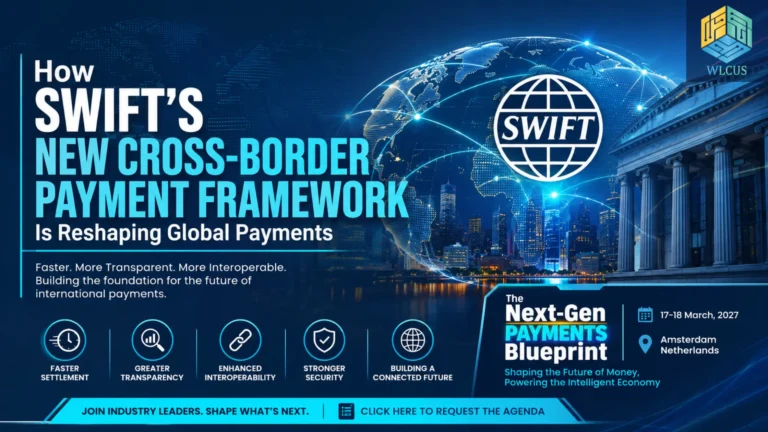
Why the latest evolution in global payment infrastructure matters for banks, payment providers, fintechs, corporates, and the future of financial services.
International payments have long been one of the most complex areas of banking.
Despite significant advancements in digital banking, businesses and financial institutions continue to face challenges including slow settlement times, limited payment transparency, fragmented infrastructures, correspondent banking complexities, and increasing regulatory obligations.
As global commerce accelerates and customer expectations continue to evolve, the financial industry is entering a new phase of transformation.
SWIFT’s latest cross-border payment framework represents another important step toward creating a faster, more transparent, and more interoperable international payment ecosystem.
Rather than replacing the existing global financial infrastructure, the initiative focuses on modernizing it, helping banks deliver faster, more predictable, and better-connected payment experiences across borders.
Why Modernizing Cross-Border Payments Matters
Cross-border payments power virtually every sector of the global economy.
Every day, trillions of dollars move between banks, corporates, payment service providers, merchants, and governments worldwide.
Yet international payments have historically involved several challenges:
- Multiple correspondent banking relationships
- Different regulatory requirements across jurisdictions
- Currency conversion complexities
- Limited end-to-end payment visibility
- Settlement delays
- Operational inefficiencies
While domestic instant payment schemes have become increasingly common, international payments often remain slower and more operationally complex.
The industry has therefore been moving toward a future where cross-border payments become:
- Faster
- More transparent
- Easier to track
- More interoperable
- Available with greater certainty
SWIFT’s latest initiative is designed to support exactly this transition.
What Is Changing?
The new framework aims to improve how participating financial institutions exchange payment information and process international transactions.
Some of the most significant developments include:
Greater Payment Transparency
Businesses increasingly expect to know:
- Where their payment is
- When it will arrive
- What fees have been deducted
- Which institutions have processed the transaction
Improved visibility throughout the payment journey helps treasury teams manage liquidity with greater confidence while reducing operational uncertainty.
Faster International Settlement
Although cross-border payments involve multiple jurisdictions and regulatory checks, the industry continues moving toward significantly faster settlement times.
By improving infrastructure coordination and reducing unnecessary friction between participating institutions, international payments are becoming more efficient than traditional legacy processes.
Improved Interoperability
The payments landscape is becoming increasingly diverse.
Banks now operate alongside:
- Instant payment schemes
- Open Banking platforms
- Payment Service Providers (PSPs)
- Digital wallets
- Embedded finance platforms
- Stablecoin ecosystems
- Tokenized financial infrastructure
Future payment success depends less on any single network and more on enabling seamless interoperability between different payment systems.
Better Customer Experience
Corporate clients increasingly expect international payments to function with the same speed and transparency as domestic transactions.
Enhanced payment tracking, predictable delivery, and clearer payment status updates improve customer confidence while reducing operational support requests.
What Does This Mean for Banks?
For banks, payment modernization is about much more than faster transfers.
It represents an opportunity to strengthen customer relationships while improving operational efficiency.
Financial institutions are increasingly investing in:
- AI-powered payment routing
- Real-time liquidity management
- Intelligent fraud detection
- ISO 20022 implementation
- Cloud-native payment platforms
- Automated compliance monitoring
Banks that successfully modernize their payment infrastructure will be better positioned to compete in an increasingly digital financial ecosystem.
Opportunities for FinTechs and Payment Providers
FinTechs have played a major role in raising customer expectations around payment speed, transparency, and digital experiences.
Modernized payment infrastructure creates opportunities for innovative providers to develop:
- Cross-border payment orchestration
- Treasury optimization tools
- Embedded finance solutions
- API-driven payment services
- AI-powered payment intelligence
- Smart transaction routing
Rather than replacing traditional banking infrastructure, collaboration between banks and FinTechs is becoming increasingly important.
Looking Beyond Speed
Payment modernization is no longer just about reducing transaction times.
It is becoming the foundation for future innovations such as:
- Programmable payments
- Digital identity
- AI-driven payment orchestration
- Tokenized assets
- Stablecoin settlement
- Central Bank Digital Currencies (CBDCs)
- Machine-to-machine payments
These innovations require payment infrastructure that is secure, interoperable, and capable of supporting increasingly intelligent financial ecosystems.
Why This Matters for the Industry
The evolution of cross-border payments reflects a broader transformation taking place across financial services.
Banks, regulators, payment providers, technology companies, and merchants are collectively building a future where payments become:
- More intelligent
- More automated
- More secure
- More transparent
- More connected
As global payment volumes continue to grow, institutions that invest early in modern payment infrastructure will be better positioned to deliver superior customer experiences while remaining competitive in an increasingly digital economy.
Join the Conversation
The future of payments extends far beyond technology, it is about collaboration across the entire financial ecosystem.
These industry developments are exactly the kind of strategic discussions that will take place at:
Shaping the Future of Money, Powering the Intelligent Economy
Join senior leaders from banks, payment service providers, fintechs, regulators, merchants, and technology innovators as we explore:
- Cross-Border Payments & Settlement
- AI-Driven Payments
- PSD3 & Open Finance
- SEPA Instant & Request-to-Pay
- Digital Assets & Stablecoins
- Embedded Finance
- Fraud Intelligence
- Financial Infrastructure
- Digital Banking Transformation
Interested in attending or speaking? Click here to request the agenda and discover how your organization can be part of Europe’s next-generation payments conversation.