The Human–AI Gap in HR:
Why Technology Is Advancing Faster Than HR Readiness
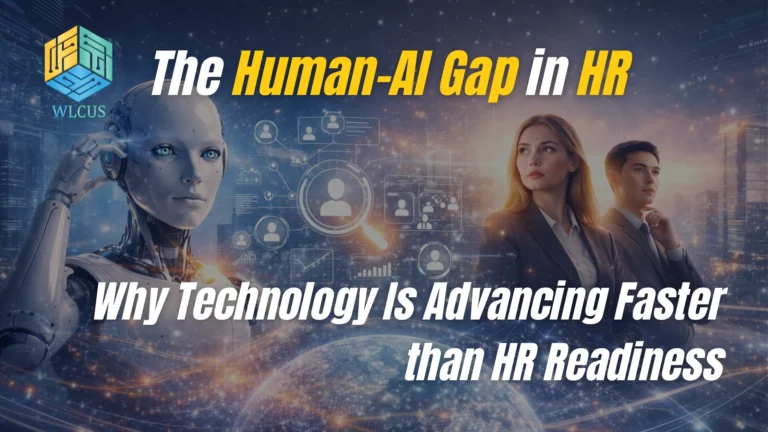
Artificial Intelligence has entered the HR function faster than any transformation HR has experienced before. Recruitment algorithms screen thousands of CVs in seconds. Predictive models forecast attrition. AI tools assess engagement, performance, and even leadership potential.
Yet behind this rapid adoption lies a growing and often uncomfortable truth: HR technology is evolving faster than HR readiness.
This widening human–AI gap is not a technology problem. It is a capability, trust, ethics, and governance challenge and it is becoming one of the most critical issues HR leaders worldwide must address in 2026 and beyond.
Understanding the Human–AI Gap in HR
The human–AI gap refers to the disconnect between:
- The speed and sophistication of AI tools, and
- The human, organisational, and ethical readiness of HR professionals to use them effectively and responsibly.
Many HR teams now operate in environments where AI:
- Influences who gets interviewed
- Shapes hiring shortlists
- Recommends promotions or exits
- Predicts employee behaviour
Yet HR professionals often lack:
- Confidence in AI outputs
- Transparency into how algorithms work
- Skills to challenge or validate AI-driven decisions
This imbalance creates risk, hesitation, and misuse, even when the technology itself is powerful.
Why AI Is Advancing Faster Than HR Readiness
1. Technology Is Built Faster Than Culture Can Change
AI vendors innovate in months. Organisational culture evolves over years.
Most HR functions were designed for:
- Human judgement
- Policy interpretation
- Relationship management
AI, by contrast, demands:
- Data literacy
- Statistical reasoning
- Algorithmic governance
- Cross-functional collaboration with IT, legal, and data teams
Without cultural and capability shifts, AI becomes something HR uses, not something HR understands.
2. HR Is Being Asked to Trust Systems It Cannot Fully Explain
One of the biggest barriers to AI adoption in HR is explainability.
When an AI tool recommends rejecting a candidate, HR leaders are expected to justify that decision, to candidates, regulators, and leadership. But many systems operate as “black boxes,” offering outcomes without clear reasoning.
This creates a dilemma:
- Trust the algorithm and risk accountability gaps
- Override the system and lose efficiency
As a result, many HR professionals experience algorithmic anxiety, using AI cautiously, inconsistently, or defensively.
3. Ethics and Bias Are Moving Faster Than Governance
AI in HR raises critical ethical questions:
- Can AI truly be unbiased if trained on biased data?
- Who is accountable for algorithmic discrimination?
- How do we balance efficiency with fairness and empathy?
While AI capabilities advance rapidly, ethical frameworks, internal governance models, and regulatory understanding lag behind.
Many organisations deploy AI tools before establishing:
- Bias audits
- Ethical review boards
- Clear accountability structures
This leaves HR leaders exposed, not only legally, but reputationally.
4. Data Quality Is Undermining AI Confidence
AI is only as good as the data it learns from.
HR data is often:
- Incomplete
- Inconsistent across regions
- Influenced by historical bias
- Poorly integrated across systems
When AI outputs don’t align with human experience, HR professionals lose trust in the technology, even if the underlying issue is data quality, not the algorithm itself.
This erodes confidence and slows adoption.
5. Skills Gap: HR Was Never Trained for Algorithmic Decision-Making
Most HR professionals were not trained in:
- Data science
- AI ethics
- Predictive modelling
- Human–machine decision collaboration
Yet modern HR now requires hybrid expertise, combining people’s insight with technological literacy.
Without structured upskilling, HR teams remain dependent on vendors and external experts, widening the human-AI gap further.
The Real Risk: Automation Without Augmentation
The greatest danger is not AI replacing HR, it is AI being implemented without human augmentation.
When AI is treated as:
- A decision-maker instead of a decision-support system
- A replacement for judgement instead of an enhancer
- A shortcut rather than a strategic capability
Organisations risk:
- De-humanised hiring
- Loss of candidate trust
- Cultural damage
- Regulatory exposure
The future of HR is not AI-driven, it is AI-augmented and human-led.
How HR Leaders Can Close the Human–AI Gap
- Redefine AI as a co-pilot, not an authority
- Build AI literacy across HR teams
- Embed ethics, governance, and transparency into AI adoption
- Align technology strategy with human capability, not speed
The Future of HR Depends on Closing the Gap
The human-AI gap is one of the defining HR challenges of this decade.
Technology will continue to accelerate. The question is whether HR leadership will evolve alongside it, or be forced to react after trust is lost.
The organisations that succeed in 2026 and beyond will be those that:
- Combine intelligence with empathy
- Balance automation with accountability
- Treat AI as a strategic partner, not a shortcut
HR’s future is not about choosing between humans or machines.
It is about designing systems where both perform better together.
Join the Global HR Leaders Shaping the Human + AI Future
The questions raised in this article are no longer theoretical, they are real, urgent, and global.
That is why senior HR leaders, CHROs, Talent Acquisition heads, HR tech innovators, and people strategists from across industries are coming together at:
SMART HR: Human + AI World Summit 2026
📍 Barcelona, Spain
📅 15–16 April 2026
This global forum is designed to move beyond hype and explore real-world AI adoption in HR, covering:
- AI-driven talent acquisition & decision-making
- Ethics, bias, and responsible AI governance
- People analytics that influence real business outcomes
- Human-centric leadership in an AI-powered workplace
If you are navigating the human-AI gap in your organisation, this is where insight turns into action.
👉 Be part of the conversation shaping the future of HR.
👉 Learn from leaders who are closing the gap, responsibly and strategically.
👉 Register or inquire about sponsorship to showcase your solutions