
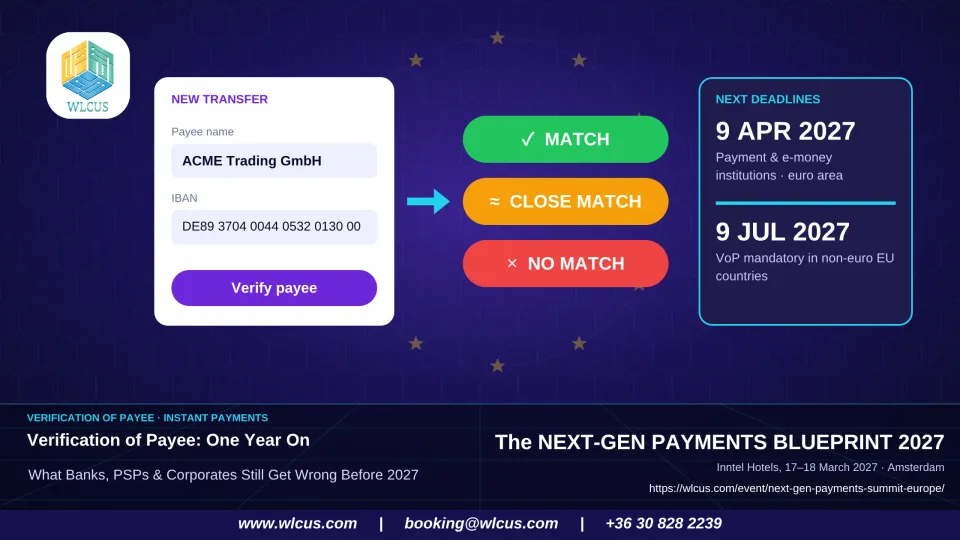
On 9 October 2025, every euro-area bank had to start checking the payee’s name against the IBAN before a euro credit transfer leaves the account. One year later, Verification of Payee (VoP) is working for consumers, but treasury teams, payment institutions and many banks are still unsure what a “close match” means, who pays when a warned payment goes wrong, and which deadlines are still ahead.
This guide explains what VoP really does, the five misunderstandings we hear most often, and the 2027 dates every payments leader in Europe should have in the diary.
Quick answer
- VoP is mandatory for euro-area PSPs since 9 October 2025, for both standard and instant euro credit transfers (ECB).
- There are four results: match, close match, no match, or verification not possible (The Paypers).
- A warning does not block the payment. The payer can still send after a close match or no match (PwC Legal), but if they approve it, the liability for a wrong payment moves to them (KPMG).
- The next big dates are in 2027: 9 April 2027 for payment and e-money institutions in the euro area, and 9 July 2027 for VoP in non-euro EU countries (ECB).
What VoP actually does
Before a euro credit transfer is authorised, the payer’s bank sends the payee name and IBAN to the payee’s bank, which compares them with its own records and returns a result in real time. The aim is to reduce misdirected payments and fraud (KPMG). It applies to standard SEPA credit transfers as well as instant ones, under Article 5c of the Instant Payments Regulation (ECB).
The early numbers are encouraging. In France, STET’s routing service reported an 80% match or partial-match rate across 180 million checks after the first month (Natixis CIB). The fraud pressure is real too: across the three years covered by the joint EBA and ECB fraud report, fraud on instant payments grew 175% while instant transaction volumes grew 98% (FinTech Weekly).
5 things banks, PSPs and corporates still get wrong about VoP
1. “A no match blocks the payment.”
It does not. The payer can still initiate the transfer after a close match or no match (PwC Legal). VoP is a warning system, not a stop button, which is why what happens next matters so much.
2. “The bank is still liable if the money goes to the wrong account.”
Not after a warning. When an organisation approves a close match or no match, it takes on the liability for an incorrect payment; with a full match, liability sits with the bank (KPMG). Treasury approval rules must reflect this.
3. “Opting out of VoP for bulk files is a safe shortcut.”
Opt-out is only possible for business customers sending more than one payment in a batch, and it is widespread: in Deutsche Bank’s January 2026 client data, 80% of SEPA credit transfer files and 67% of SEPA Instant files were opt-outs (FinTech Weekly). The ECB has said VoP in company ERP systems is lagging. Opting out keeps payments flowing, but it also gives up the fraud check.
4. “A close match is just a typo problem.”
Often it is a data problem. Trading names, legal names, abbreviations and payments collected on behalf of third parties can all produce close-match or no-match results (Euro Banking Association). Pre-validation services can catch these cases before files reach the bank (KPMG).
5. “VoP is done. It went live in 2025.”
For much of the market it has not even started. Payment and e-money institutions in the euro area must send and receive instant euro payments from 9 April 2027, and VoP becomes mandatory in non-euro EU countries on 9 July 2027 (ECB). In a Celent survey commissioned by ClearBank, one in five EMIs and PIs expected to miss the July 2027 deadline by three to six months (FinTech Weekly).
The Instant Payments Regulation dates still ahead
| Date | Who | What |
|---|---|---|
| 9January 2027 | PSPs in non-euro EU countries | Receive instant euro payments |
| 9 April 2027 | Payment and e-money institutions (euro and non-euro area) | Receive instant euro payments |
| 9 April 2027 | Payment and e-money institutions in the euro area | Send instant euro payments |
| 9 July 2027 | PSPs in non-euro EU countries | Send instant euro payments and offer VoP |
| 9 July 2027 | Payment and e-money institutions in non-euro countries | Send instant euro payments |
| 9 June 2028 | Non-euro countries | Send outside business hours from national-currency accounts |
Source: ECB, Instant Payments Regulation. Looking further ahead, the EBA expects PSD3 and the Payment Services Regulation to extend VoP to all EU currencies (FinTech Weekly).
What to do now
If you are a bank or PSP
- Track your close-match and no-match rates by customer segment, not just in total.
- Give corporate clients clear warning screens and API results they can act on, so fewer of them opt out of bulk checks.
- Review how you handle payments collected on behalf of third parties, a common source of no-match results.
If you are a payment or e-money institution
- Treat 9 April 2027 (euro area) and 9 July 2027 (non-euro area) as hard dates, not targets.
- Test your VoP flows end to end with your sponsor bank or scheme provider well before go-live.
If you run treasury or accounts payable
- Clean supplier master data: legal names, not trading names, matched to each IBAN.
- Update approval rules: a person who approves a close match or no match is accepting the liability.
- Ask your bank about pre-validation before you choose to opt out of VoP for bulk files.
For the wider fraud picture, read our guide on how Europe is building shared defences against APP fraud. For the instant-payments race, see Can Wero and SEPA Instant beat cards? and who pays the price for Europe’s 24/7 money economy.
Frequently asked questions
What is Verification of Payee?
A free check, required by the EU Instant Payments Regulation, that compares the payee’s name with the IBAN before a euro credit transfer is sent.
When did VoP start?
On 9 October 2025 for payment service providers in the euro area.
What does a close match mean?
The name is similar but not identical to the bank’s records. The payer is shown the name held by the payee’s bank and can correct it before sending.
Can I still send a payment after a no match?
Yes. But if you approve it and the money goes to the wrong account, you carry the liability.
Can businesses opt out of VoP?
Only non-consumers sending more than one payment in a batch. Single payments cannot be opted out.
When does VoP apply outside the euro area?
From 9 July 2027 for payment service providers in non-euro EU countries.
Does VoP apply to payment and e-money institutions?
They come into scope as they join instant payments: 9 April 2027 in the euro area and 9 July 2027 outside it. Check the exact obligations with your scheme provider.
Discuss it live at the Next-Gen Payments Blueprint 2027, Amsterdam
The 2027 deadlines arrive fast. The Next-Gen Payments Blueprint 2027 takes place on 17–18 March 2027 at Inntel Hotels Amsterdam Zaandam, just three weeks before payment and e-money institutions in the euro area must be live with instant payments on 9 April 2027.
It brings together 350+ delegates from 25+ countries and 30+ speakers shaping the future of money in Europe. Bring your VoP questions and compare notes with peers facing the same deadlines.
Join us in Amsterdam at the Next-Gen Payments Blueprint 2027.
Click here for more details and to book your place.
To receive the full agenda, email booking@wlcus.com.