
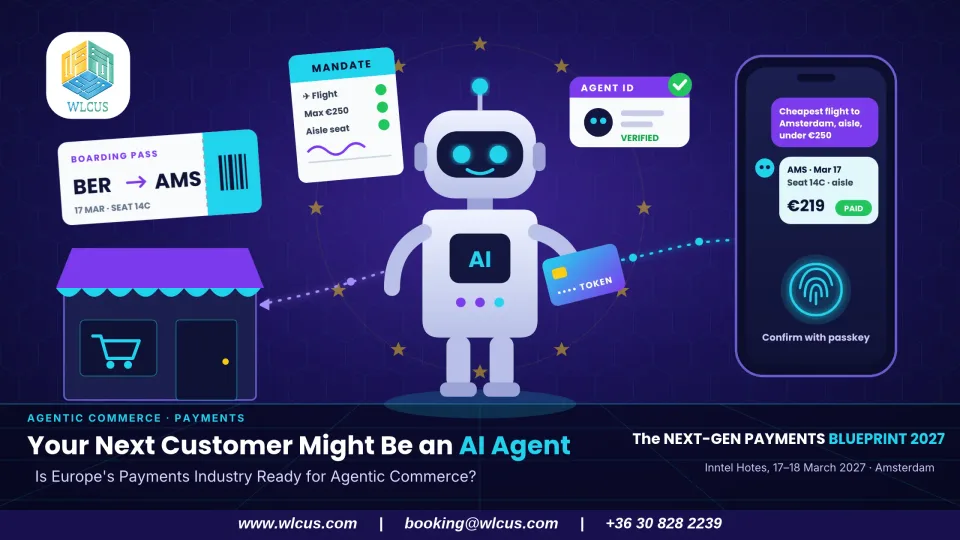
Picture this. It’s a Tuesday evening and you tell your phone: “Find me a flight to Amsterdam in mid-March, aisle seat, nothing over €250.” You put the kettle on. By the time it boils, the ticket is booked and paid for. You never typed a card number. You never opened an airline website.
A year ago that would have sounded like a slick demo. Today it’s quietly happening. Over the past twelve months, AI agents have started making real purchases at real European shops, running on regulated bank infrastructure rather than in a lab.
So the question we keep hearing from banks, payment providers and merchants has changed. It’s no longer “Will software become a customer?” It’s “How do we serve that customer safely, and without losing the relationship with the human behind it?”
What Is Agentic Commerce?
In plain terms, agentic commerce is when an AI agent stops just recommending things and starts doing them. It searches, compares, picks and pays on someone’s behalf, inside limits that person has agreed to.
People in the industry like to describe it as AI moving from assistant to actor. That sounds like a small shift. It isn’t. Every payment suddenly has an extra participant sitting between the customer and the merchant, and that touches almost everything: how we authenticate, how we spot fraud, how checkouts are designed, who’s liable when something goes wrong, and who the customer is actually loyal to.
2026: The Year AI Agents Paid for Real in Europe
If you blinked, you might have missed how fast this moved. A quick recap of the year so far:
- March. Banco Santander and Mastercard completed what both described as Europe’s first live agentic payment, on Santander’s production systems rather than a test environment.
- Also March. In London, Visa launched its Agentic Ready programme for European card issuers, choosing Europe as the first region to test agent-initiated payments with real banks and merchants.
- July. At the Visa Payments Forum in Paris, Visa confirmed live agentic commerce transactions with more than 30 European banks, among them Barclays, BBVA, HSBC UK, Lloyds Banking Group, Revolut and Klarna. Every one of those payments was confirmed with a payment passkey.
- Through the year. Worldline and ING, working with Mastercard and Visa, showed end-to-end agentic payments running on today’s payment rails, with no new infrastructure needed.
That last point is the one worth underlining. The plumbing already works. What’s still being figured out is the harder, more human stuff: trust, rules and how everyone gets paid.
Why Europe Is Doing Agentic Commerce Its Own Way
In some markets, agentic commerce is mostly a technology race. Europe is taking a different route, where the rules are being written alongside the product. It can feel slower. It may also turn out to be Europe’s biggest advantage.
Three pieces of regulation are converging here, as Reply’s analysis of agentic checkout in Europe points out: PSD3 and the Payment Services Regulation (PSR), eIDAS 2.0 for digital identity, and the EU AI Act.
Here’s the interesting wrinkle. Strong Customer Authentication was built on the idea that a person is standing there, pressing “confirm”. When an agent is acting under a mandate the customer approved last week, that assumption gets fuzzy. Is it a customer-initiated payment? A merchant-initiated one? Something new? Lawyers at Osborne Clarke expect consent, authentication and liability rules for agentic payments to be where guidance develops next.
Get this right, and Europe doesn’t just catch up. It sets the template the rest of the world uses for safe autonomous payments.
The New Trust Stack: Know Your Agent, Digital Mandates and Passkeys
For decades, KYC has answered one question: who is this customer? Agentic commerce adds a second one that’s just as important: who is this agent, and what exactly is it allowed to do?
From what we’re seeing across the market, the answer is coming together in four layers:
- Know Your Agent (KYA). Before a merchant accepts an order, it needs to know the agent is genuine and registered, not a bot dressed up as one. Visa’s Trusted Agent Protocol and its Agent Directory are early examples of how this works in practice.
- Digital mandates. Think of these as a signed permission slip: what the agent may buy, which payment method it can use, and the most it can spend. The mandate ties the customer, the agent and the payment together so anyone in the chain can check it.
- Tokens and passkeys. The agent never sees a real card or account number. A biometric passkey keeps the customer firmly in charge.
- Real-time risk intelligence. Fraud models trained on human behaviour will need to learn what normal looks like for an agent, too.
There’s a real opportunity hiding in here for banks. Whoever holds the mandate holds the trust, and banks are in a natural position to become the layer that lets people hand off their shopping without handing over control.
What Agentic Commerce Means for Banks, Merchants and PSPs
If you’re a bank or card issuer, this is a chance to own the mandate and the trust relationship. As agents become a new front door to customers, that’s how you stay part of the conversation. Agent controls and spending limits could easily become a premium feature people are happy to pay for.
If you’re a merchant, the uncomfortable truth is simple: if an AI agent can’t read your catalogue, prices and checkout, you may as well not exist on that channel. Clean product data, tokenised checkout and support for the payment methods people actually use will matter more than another banner ad.
If you’re a PSP or fintech, orchestration, tokenisation, smart routing and agent verification are turning into real product lines, not just features.
If you work in fraud, risk or compliance, the job grows rather than shrinks. You’ll need audit trails for decisions no human made directly, fraud models that understand agents, and a way to check mandates in real time.
Is Your Business Agent-Ready? A Quick Checklist for 2027
Be honest with yourself on these:
- Can your systems tell a verified AI agent apart from an ordinary bot?
- Can customers set, see and cancel what their agents are allowed to do, easily?
- Is your product and pricing data readable by machines, not just people?
- Do your fraud models score agent behaviour, or only human behaviour?
- Is there a clear audit trail for every decision an agent makes?
- Does your PSD3/PSR roadmap cover delegated payments?
- Do you know which partners (networks, PSPs, AI platforms) you’d need to make it all work together?
If you answered “not yet” to three or more, you’re in good company. Most of the industry is in the same spot, which is exactly why these conversations need to happen face to face.
Continue the Agentic Payments Conversation in Amsterdam
We built Day 2 of the Next-Gen Payments Blueprint 2027 summit in Amsterdam (17–18 March 2027) around this very shift: compliance, monetisation and autonomous commerce. We won’t give the whole programme away, but here’s a taste:
- An opening keynote on the “agentic enterprise” from Adem Yekeler, Head of Payments & Cards at ING Belgium, looking at what happens when AI agents run financial workflows within set risk limits, and when machines start paying machines.
- A merchant session on smarter checkouts and alternative payment methods, led by Kai Lindström, Chairman of the Board at the European Commerce Innovation Council.
- Closed-door roundtables on AI and fraud intelligence, embedded finance and checkout conversion, with leaders including Saskia Devolder, Head of Visa Direct Central Europe at Visa.
- A closing keynote that looks ahead to 2035: invisible payments, embedded economies and fully autonomous financial ecosystems.
You’ll be in the room with more than 300 senior people from banks, fintechs, merchants, regulators and payment infrastructure bodies. Just as many of the useful conversations will happen over coffee as on stage.
Book your place at the Next-Gen Payments Blueprint 2027. Want the full agenda? Email booking@wlcus.com. Interested in speaking or sponsoring? Send a sponsorship enquiry.
Keep reading on WLCUS:
- What 24/7 instant payments really cost Europe’s banks and PSPs
- How Europe is building shared defences against APP fraud and payment scams
Frequently Asked Questions
What is agentic commerce?
Agentic commerce is when an AI agent searches, selects and pays for goods or services on a customer’s behalf, within limits the customer has approved.
Are AI agent payments live in Europe?
Yes. During 2026, Mastercard with Santander and Visa with more than 30 European issuers carried out live agent-initiated payments at real merchants.
Are agentic payments safe?
They are built on tokenisation, biometric passkeys, verified agent identities and digital mandates, so the agent never sees raw card details and the customer stays in control.
How does PSD3 affect agentic payments?
PSD3 and the PSR update Europe’s rules on authentication, fraud and data access. How Strong Customer Authentication applies to delegated, agent-initiated payments is one of the key topics for 2027.
Where can I learn more about agentic commerce in 2027?
At The Next-Gen Payments Blueprint 2027, 17–18 March 2027 in Amsterdam, where Day 2 focuses on autonomous commerce, AI-driven payments and Open Finance.