
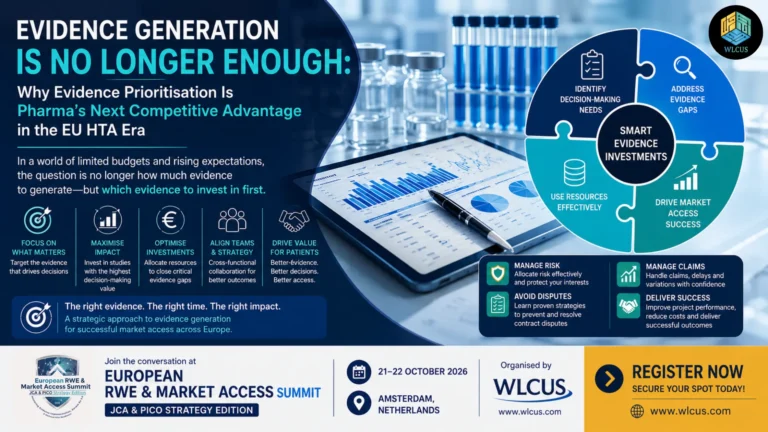
The Industry Has Moved Beyond Generating More Evidence
For years, pharmaceutical innovation has focused on answering one fundamental question:
“Do we have enough evidence to secure regulatory approval?”
Today, that question has evolved.
Across Europe, Market Access, HEOR, Medical Affairs, Clinical Development, and Real-World Evidence (RWE) teams are increasingly asking a different question:
“Which evidence should we prioritise because we cannot fund everything?”
This subtle shift reflects one of the biggest strategic changes currently taking place within pharmaceutical organisations.
The implementation of the European Union Health Technology Assessment (EU HTA) Regulation together with the growing use of Joint Clinical Assessments (JCA), increasing payer expectations, and continued pressure on healthcare budgets, means that evidence generation is no longer measured by quantity alone.
Competitive advantage now depends on generating the right evidence, at the right time, for the right decision-makers.
Why Evidence Prioritisation Matters More Than Ever
Every pharmaceutical company faces the same reality.
Resources are limited.
Development timelines are becoming shorter.
Evidence expectations continue to expand.
Market Access teams are expected to support successful reimbursement across multiple European countries, while Clinical Development teams continue focusing on regulatory milestones.
At the same time, leadership teams are being asked to justify every evidence-generation investment.
Should resources be allocated towards another comparative effectiveness study?
Would additional patient-reported outcomes provide greater value?
Should investment focus on long-term Real-World Evidence or health economic modelling?
Could AI accelerate evidence synthesis without compromising scientific quality?
These questions rarely have simple answers.
Choosing one evidence programme often means delaying another.
That makes evidence prioritisation both a scientific and commercial decision.
The Stakeholders Have Changed, So Have Their Questions
One medicine now serves multiple decision-makers.
Each stakeholder evaluates value differently.
| Stakeholder | Primary Question |
|---|---|
| Regulators | Is the medicine safe, effective and of appropriate quality? |
| HTA Bodies | How does it compare with existing standards of care? |
| National Payers | Does it provide sufficient value for reimbursement? |
| Clinicians | Will this improve patient outcomes in routine practice? |
| Patients | Will this improve quality of life and treatment experience? |
Generating evidence that satisfies only one of these groups is no longer enough.
Today’s evidence strategies must support multiple conversations simultaneously.
Evidence Generation Is Becoming a Portfolio Strategy
Leading pharmaceutical companies are increasingly treating evidence generation like portfolio management rather than a series of independent projects.
Instead of asking,
“What additional studies can we perform?”
they ask,
“Which evidence investments will have the greatest impact across the product lifecycle?”
This approach enables organisations to focus investment where evidence is most likely to influence regulatory decisions, HTA assessments, pricing negotiations, reimbursement outcomes, scientific publications, and long-term commercial success.
Rather than generating evidence reactively, organisations are beginning to prioritise evidence proactively.
Five Strategic Questions Every Market Access Leader Should Be Asking
Before approving another study, organisations should ask themselves five important questions.
1. Which evidence gap creates the greatest reimbursement risk?
Not every uncertainty carries the same commercial impact.
Understanding which evidence gaps could delay patient access allows organisations to focus investment where it matters most.
2. Can one study answer multiple stakeholder questions?
The most valuable evidence often supports regulators, HTA bodies, payers, clinicians and scientific publications simultaneously.
Maximising the value of each study improves both efficiency and return on investment.
3. Are we generating evidence for today’s requirements, or tomorrow’s?
Healthcare decision-making continues to evolve.
Evidence strategies should anticipate future expectations rather than responding only to current requirements.
4. How can Real-World Evidence complement clinical trials?
Randomised clinical trials remain essential.
However, Real-World Evidence can provide valuable insights into long-term effectiveness, healthcare resource utilisation, treatment persistence, patient outcomes and comparative effectiveness.
As the use of Real-World Evidence continues to expand across Europe, pharmaceutical companies are also following initiatives led by the European Medicines Agency (EMA), including the Data Analysis and Real World Interrogation Network (DARWIN EU®), which supports the use of high-quality real-world data to strengthen evidence generation for regulatory decision-making.
Planning these activities early creates greater flexibility after launch.
5. Are our teams working towards shared priorities?
Clinical Development, Medical Affairs, Market Access, HEOR, Epidemiology and Commercial Strategy all contribute to evidence generation.
When these teams operate with shared objectives, organisations are better positioned to identify gaps early, reduce duplication and improve decision-making.
"Generating more evidence is no longer the objective. Generating the right evidence is becoming pharma's next competitive advantage."
Why Cross-Functional Collaboration Is Becoming a Competitive Advantage
The organisations making the greatest progress are no longer treating evidence generation as the responsibility of a single department.
Instead, they are bringing together expertise from across the organisation to develop integrated evidence strategies.
Cross-functional collaboration enables teams to:
- Identify evidence gaps earlier.
- Align development with future market access objectives.
- Improve consistency across evidence packages.
- Reduce duplication of effort.
- Support more informed investment decisions.
In many organisations, evidence planning is becoming one of the few activities that genuinely connects scientific, clinical and commercial teams.
Beyond Compliance: Preparing for the Next Phase of EU HTA
The implementation of Joint Clinical Assessments represents a significant milestone for European collaboration.
However, successful market access will continue to depend on national pricing and reimbursement decisions.
This means pharmaceutical companies must think beyond regulatory compliance.
Future evidence strategies will increasingly combine:
- Clinical trial evidence.
- Real-World Evidence.
- Health economic analyses.
- Patient-reported outcomes.
- Comparative effectiveness research.
- Long-term evidence generation.
The companies that integrate these activities into a single evidence strategy are likely to be better prepared for the next generation of market access challenges.
Why This Conversation Matters Now
Across the pharmaceutical industry, evidence prioritisation is rapidly becoming a boardroom discussion rather than simply an operational activity.
Senior leaders are increasingly recognising that evidence generation is no longer measured by the number of studies conducted, but by the quality of decisions those studies support.
As budgets remain under pressure and healthcare systems continue demanding greater value, organisations that prioritise evidence strategically may achieve faster reimbursement discussions, stronger payer engagement and more efficient product launches.
Continue the Conversation at the European RWE & Market Access Summit 2026
The topics explored in this article, including evidence prioritisation, Real-World Evidence, EU HTA implementation, pricing and reimbursement, and market access strategy—will be discussed by senior leaders from pharmaceutical companies, HTA bodies, payer organisations, regulators, academia, and solution providers at the
European RWE & Market Access Summit – JCA & PICO Strategy Edition.
21–22 October 2026
Amsterdam, Netherlands
Click here to Request the Agenda
Click here to Register Now
Related Insight
If you’re interested in how pharmaceutical companies are preparing for the new EU HTA landscape, read our previous article:
➡ Overcoming ‘PICO Anxiety’: How Biopharma Can Master the New European HTA Era