
EU Machinery Regulation 2027: What Changes on 20 January and What HSE Leaders Must Do Now
Picture a Friday night shift. A line keeps tripping on a light curtain, so a maintenance tech tweaks the PLC logic to stop the nuisance stops. Production is happy. Nobody fills in a form.
From 20 January 2027, that small fix could make your site the legal “manufacturer” of that machine.
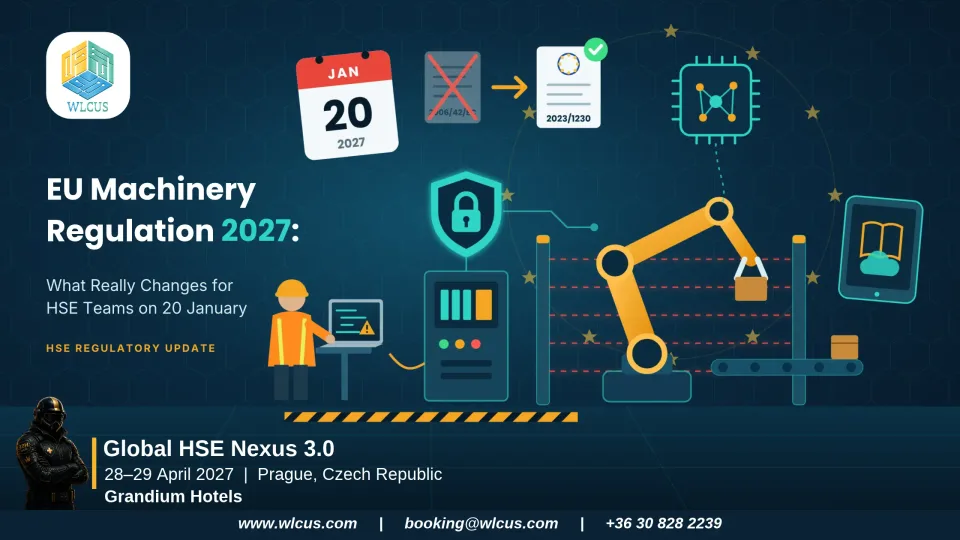
That’s the date the EU Machinery Regulation 2027, officially Regulation (EU) 2023/1230, takes over from the Machinery Directive 2006/42/EC. Most of the coverage so far has been aimed at machine builders. But the people who’ll feel it day to day are the ones who buy, run, fix and upgrade machines: HSE managers, maintenance leads and plant engineers. If that’s you, here’s what you actually need to know.
Why a regulation and not a directive?
The old directive had to be copied into national law, country by country, and each country did it a little differently. A regulation doesn’t work like that. It applies directly, word for word, in all 27 member states. And there’s no grace period after 20 January. From that day, new machinery placed on the EU market has to meet the new rules.
Your existing machines? They’re fine. Anything lawfully placed on the market before 20 January 2027 under the old directive stays lawful, and you don’t need to recertify your fleet. What changes is what happens when you start modifying those machines.
Five changes in the new Machinery Regulation that HSE managers should care about
1. Modify it, and you may own it
The regulation defines a “substantial modification” as a change the original manufacturer didn’t foresee, which creates a new hazard or raises an existing risk, and which needs new guards, protective devices or other protective measures to deal with it. Under Article 18, whoever makes that change picks up the manufacturer’s duties, conformity assessment and declaration of conformity included.
Here’s the part many people miss: the change doesn’t have to be physical. New control logic, a new operating mode or a software update can all count. So a weekend retrofit by your own team can quietly move legal responsibility from the supplier to you.
2. Software and AI are now safety questions
Safety components used to mean physical parts like guards and light curtains. Now software that performs a safety function is covered too. The regulation also deals directly with machines and safety systems that learn and change their behaviour through machine learning. Where those systems handle safety functions, they sit on the high-risk list in Annex I, Part A, so a notified body has to assess them. Self-declaration isn’t enough.
3. Cybersecurity is part of machine safety
Safety functions and control systems must be protected against corruption, whether it’s an honest mistake or a deliberate attack. In practice, your OT security people and your HSE team now need to be talking regularly, if they aren’t already.
4. People working with autonomous machines
The ergonomic requirements now cover operator stress and the way people work alongside collaborative and autonomous machines. Autonomous mobile machinery must also stay within its defined tasks and movement space.
5. Manuals can go digital
Instructions and the declaration of conformity can be supplied digitally, as long as they stay available for the machine’s lifetime and for at least ten years. Buyers can still ask for a free paper copy. It’s worth adding that to your purchasing terms now.
What about the EU AI Act?
This confused a lot of people this year. In July 2026, the Digital Omnibus on AI (Regulation (EU) 2026/1744) moved machinery to a sector-specific approach. Put simply, the AI Act’s high-risk requirements for machinery will be written into the Machinery Regulation itself, through a delegated act due by August 2028, rather than applied as a second, separate set of rules.
What didn’t move is the date. 20 January 2027 still stands.
Why this is an HSE issue, not just an engineering one
Look back at most serious incidents and you’ll often find non-routine work behind them: a changeover, a maintenance job, a trial run, a “temporary” fix that never got undone. We wrote about this in When Routine Maintenance Becomes a Critical Risk. The new regulation adds a legal edge to exactly those moments. A bypassed guard, a robot cell added over a long weekend, an AI camera wired into a safety function: each one could trigger new obligations.
Honestly, that’s an opportunity. HSE teams have asked for years to be involved earlier in engineering changes, purchasing and digital projects. Now there’s a clear legal reason to be in the room from the start, which is where serious injury and fatality (SIF) prevention works best.
A practical checklist before 20 January 2027
- Build a simple register of your machines: supplier, CE paperwork and the date each one was placed on the market.
- Add a “substantial modification?” question to your management of change process, and name someone competent to answer it with a risk assessment.
- Log every modification, hardware and software, with approval and risk assessment references.
- Update purchasing specs. Ask suppliers for declarations under the new regulation, ten-year digital access to instructions, and cybersecurity information.
- Get OT security and HSE in the same room and agree who protects safety-related control systems.
- Brief supervisors and maintenance teams so they can spot when an “improvement” might become a substantial modification.
None of this is complicated. Most of it is good management of change that many sites already do on paper. The difference now is that it carries legal weight.
Talk it through with peers in Prague
By the time Europe’s HSE leaders meet at Global HSE Nexus 3.0 on 28–29 April 2027 at the Grandium Hotel Prague, the regulation will have been live for three months. That’s long enough for real lessons to come out. The agenda includes a European HSE Legal & Regulatory Update, a Standards & Assurance Forum (ISO 45001, 14001 and 9001), sessions on AI and predictive analytics, and a Technology Innovation & Connected Worker Pavilion.
Prague is a good fit for this conversation. It sits in the middle of Europe’s automotive and manufacturing belt, and the speakers include HSE leaders from ŠKODA AUTO, ZF Group, Volvo Group, Siemens Healthineers, Rolls-Royce, BASF, RWE and Norsk Hydro. Expect more than 300 senior HSE, operations, risk and ESG leaders, and plenty of time to compare notes.
Book your place at Global HSE Nexus 3.0. Want to see the full agenda first? Email booking@wlcus.com.
More from the WLCUS blog
- The “Normal Work” Paradox: What 90 Days Without an Injury Can Hide
- The Future of HSE Leadership in 2027: AI, Risk Management and Safer Workplaces
- Europe’s 3,367 Workplace Deaths: Why Safety Leadership Must Change in 2027
This article is general information, not legal advice. For specific machines or modifications, speak to a qualified machinery safety specialist.
Frequently asked questions
When does the EU Machinery Regulation 2027 apply? Regulation (EU) 2023/1230 applies from 20 January 2027 and replaces the Machinery Directive 2006/42/EC on that date.
Do existing machines need to be recertified? No. Machinery lawfully placed on the market before 20 January 2027 under the Directive remains lawful. New obligations can arise if you substantially modify it.
What is a substantial modification? A change not foreseen by the original manufacturer that creates a new hazard or increases an existing risk, and that needs new guards, protective devices or other protective measures. It can be physical or digital, and whoever makes it takes on the manufacturer’s obligations.
Does the Regulation cover AI and cybersecurity? Yes. Safety components with self-evolving, machine-learning behaviour are addressed directly, and safety functions must be protected against accidental or malicious corruption.
Where can HSE leaders discuss the new rules? At Global HSE Nexus 3.0, 28–29 April 2027 in Prague, which includes a European HSE Legal & Regulatory Update and a Standards & Assurance Forum.